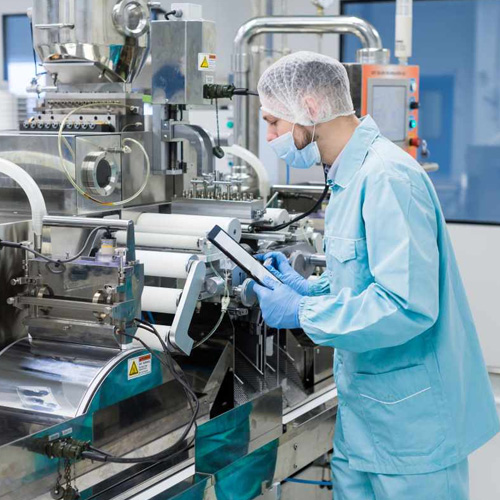

- What are Ampoule Processing Machines?
- The ampoule processing line — how the four machines work together
- The four ampoule processing machines we manufacture
- When do you need a complete line vs a single machine?
- Where are ampoule processing lines used?
- Why choose our ampoule processing machines
- Frequently Asked Questions
What are Ampoule Processing Machines?
Ampoule Processing Machines are a category of pharmaceutical equipment used to manufacture sterile liquid injectables in hermetically sealed glass ampoules. The category covers four machine types that operate in a fixed sequence: washing (cleans the outside of empty ampoules), filling (dispenses sterile liquid into open ampoules under laminar airflow), sealing (flame-fuses the ampoule neck into a hermetic closure), and labeling (applies batch-coded self-adhesive labels). Ampoule processing machines are used in small-volume parenteral (SVP) manufacturing — the production of sterile injectable drugs in volumes typically ranging from 1 ml to 20 ml per dose. End products include vaccines, water-for-injection, diagnostic reagents, hormonal injectables, biologics, lyophilized (freeze-dried) products, and veterinary injectables. All four machine types in an ampoule processing line are designed to operate under cGMP conditions. Modern lines integrate filling and sealing into a single monoblock machine inside an ISO 5 / Grade A laminar airflow cabinet, while washing and labeling operate upstream and downstream respectively under ISO 7 / Grade B background.
Products
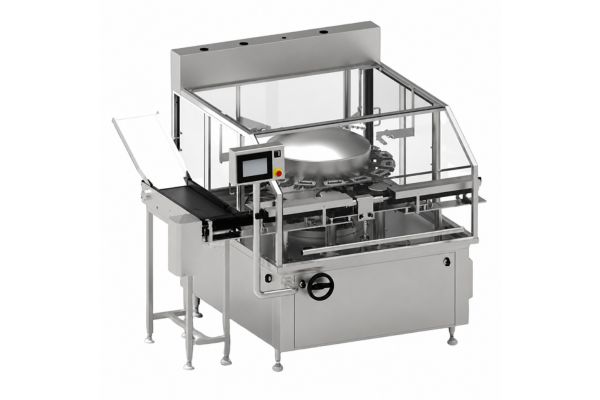
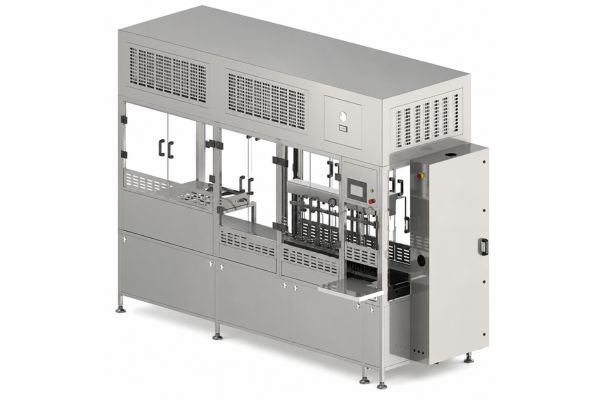
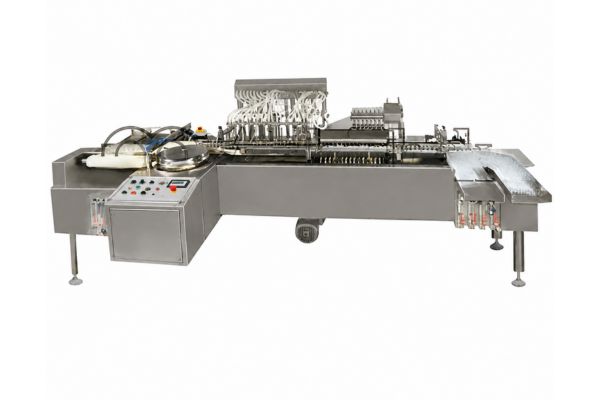
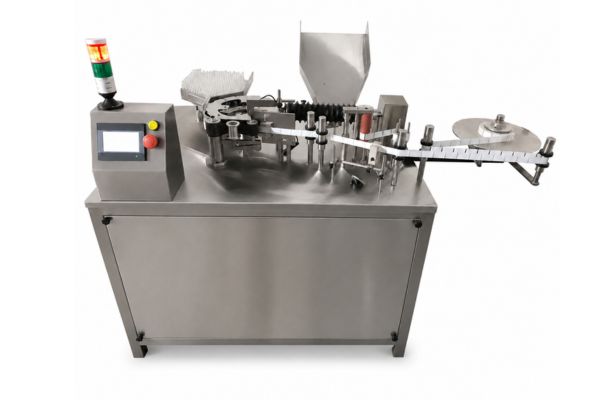
The Ampoule Processing Line — How the Four Machines Work Together
An ampoule processing line is a tightly synchronized sequence of four machine stations. Each machine receives ampoules from the previous station on a matched stainless-steel conveyor and discharges them at the same speed, pitch, and orientation. Operator handling between stations is eliminated to preserve the aseptic envelope.
Step 1 – Ampoule Washing Machine
Empty glass ampoules arrive on the infeed conveyor, are inverted mouth-down, and pass through 4–6 spray zones that deliver purified water (USP <645>) and WFI (USP <1231>) to the outside surface. HEPA-filtered air blow-off leaves the ampoules dry to the touch, ready for the filling station. Standard configurations handle 80–400 ampoules/minute depending on the number of wash zones and the ampoule format.
Step 2 – Ampoule Filling Machine
Cleaned ampoules arrive mouth-up and are indexed under a filling needle. The product is metered by a volumetric piston, peristaltic pump, servo-driven ceramic piston, or time-pressure system depending on the fill accuracy and sterility requirements. Aseptic models sit inside an ISO 5 / Grade A laminar airflow cabinet. Fill accuracy ranges from ±0.3% (servo) to ±1% (time-pressure).
Step 3 – Ampoule Sealing Machine
Filled ampoules are indexed into the sealing station, where each ampoule is gripped by a precision chuck and rotated through a focused LPG + Oxygen flame (1200–1600 °C). The molten neck fuses into a hermetic seal in 1–3 seconds. In high-speed lines, the filling and sealing stations are combined into a single monoblock with a shared laminar airflow cabinet.
Step 4 – Ampoule Sticker Labeling Machine
Sealed ampoules are discharged to the labeling station, where a self-adhesive label is dispensed from a reel and applied to the upright ampoule by a pressure roller (vertical orientation) or by a friction belt that wraps the label around the ampoule body (wrap-around). An integrated inkjet printer applies batch number, manufacturing date, expiry, and MRP. Optional vision inspection verifies label presence, position, and code readability with auto-reject.
Once labeled, ampoules move to secondary packaging — blister packing, cartoning, case packing,and palletizing. The ampoule processing line ends here; everything downstream is secondary packaging equipment outside the scope of this category.
The Four Ampoule Processing Machines We Manufacture
We build all four machines in this category — washing, filling, sealing, and labeling — at our Ahmedabad facility. Each machine has its own dedicated product page with full specifications, types, and FAQs. Click through to compare variants and request a quote.
Step 1 – Ampoule Washing Machine
External, internal + external, ultrasonic, and air-jet configurations. 40–400 ampoules/min. WFI final rinse, HEPA-filtered air blow-off.
Step 2 – AAmpoule Filling Machine
Volumetric piston, peristaltic, servo-driven, time-pressure, and vacuum types. ±0.3% to ±1% fill accuracy. Optional LAF cabinet.
Step 3 – Ampoule Sealing Machine
Single-head, multi-head linear, rotary, and filling-and-sealing monoblock. LPG + Oxygen flame, 1200–1600 °C, hermetic closure.
Step 4 – Ampoule Sticker Labeling Machine
Vertical orientation, wrap-around, two-side, and top + wrap configurations. Servo-driven, ±1 mm accuracy, optional inkjet coding.
When Do You Need a Complete Ampoule Processing Line vs a Single Machine?
Most buyers eventually need the full four-machine line — but the entry point depends on your stage of growth. Here is a practical decision guide:
| Your Situation | What You Need | Why |
|---|---|---|
| Starting a New SVP Injectable Facility | Complete four-machine ampoule production line | All four processing stages are required to produce a completely finished and labelled ampoule. |
| Replacing One Machine on an Existing Line | A single replacement machine matched to the existing production line | The replacement machine must match the existing line speed, ampoule pitch, working height and PLC communication handshake. |
| Upgrading from Semi-Automatic to Automatic | Complete production-line upgrade with machine integration | Higher production output requires synchronised conveyors, PLC communication between machines and a shared laminar airflow system. |
| Adding Ampoules to an Existing Vial Line | Ampoule-specific washing, filling, sealing and labelling equipment | Ampoule-processing equipment cannot normally be used interchangeably with vial equipment without extensive retooling and format-part changes. |
| R&D or Pilot Plant with Low Output | Single-head machines with manual material handling | This configuration offers lower capital investment, greater format flexibility and does not require conveyor integration. |
| CDMO Running Multi-Client Ampoule Production | Complete line with HMI recipe storage on every machine | Stored recipes support ampoule-format changeovers across all four machines in less than 30 minutes. |
Rule of thumb: If you are starting from scratch, request a quotation for the full 4-machine line from a single supplier. This avoids integration risk, gives you a single point of accountability for validation, and typically lowers total cost by 10–15% versus sourcing from four different vendors.
Where are Ampoule Processing Lines used?
Ampoule Processing Machines are used in any pharmaceutical manufacturing facility that produces sterile liquid injectables in glass ampoules. Typical users include:
- Small-volume parenteral (SVP) injectables manufacturers — the largest user base for ampoule processing lines
- Vaccine manufacturers — where ampoules remain the traditional primary container
- Lyophilized (freeze-dried) product manufacturers — filling ampoules after reconstitution
- Diagnostic reagent manufacturers — small-volume ampoules for clinical chemistry kits
- Veterinary injectable manufacturers
- Contract Development & Manufacturing Organizations (CDMOs) running multi-client ampoule lines
- Ophthalmic and nasal spray manufacturers in small ampoule formats
- Biologics and biosimilar manufacturers in clinical and commercial batches
- Government and military pharma units producing field-deployable injectables
- Generic injectables exporters shipping to 25+ countries
Why choose our Ampoule Processing Machines
We build all four machines in the ampoule processing category under one roof. This means a single point of accountability, matched integration, and consolidated validation — advantages you do not get when sourcing from four different vendors. Here is what we do differently:
30+ years of pharma-machinery experience
Every machine ships from an Ahmedabad facility that has supplied ampoule processing lines to 25+ countries.
Single-source line integration
All four machines built in-house — conveyors, PLCs, and HMIs are matched at the design stage, not retrofitted on site.
Step 3 – Ampoule Sealing Machine
Single-head, multi-head linear, rotary, and filling-and-sealing monoblock. LPG + Oxygen flame, 1200–1600 °C, hermetic closure.
Full IQ/OQ/PQ documentation
DQ, IQ, OQ, PQ protocols, MTCs, surface roughness reports, FAT and SAT reports — bundled across all four machines.
Monoblock configuration
Filling + Sealing integrated into a single monoblock with shared LAF cabinet — the gold standard for aseptic injectable lines.
21 CFR Part 11 ready
PLCs and HMIs are 21 CFR Part 11 compliant with audit trail, electronic signatures, and user-level access control on request.
Quick format changeover
Tool-free changeover between ampoule sizes in < 30 minutes across all four machines (servo-driven recipe storage).
After-sales support
12-month comprehensive warranty on the full line, lifetime remote support, spare parts dispatched within 24–48 hours globally.
Frequently Asked Questions
Ampoule Processing Machines are a category of pharmaceutical equipment used to manufacture sterile injectables in glass ampoules. The category includes four main machine types: Ampoule Washing Machine (cleans the outside of empty ampoules), Ampoule Filling Machine (dispenses sterile liquid into open ampoules), Ampoule Sealing Machine (flame-seals the ampoule neck), and Ampoule Sticker Labeling Machine (applies batch-coded labels). Together, these four machines form a complete ampoule processing line for small-volume parenteral (SVP) injectables.
An ampoule processing line runs in this fixed sequence: (1) Ampoule Washing — external cleaning of empty glass ampoules with purified water and WFI; (2) Ampoule Filling — sterile dispense of liquid into the ampoule under laminar airflow; (3) Ampoule Sealing — flame fusion of the open ampoule neck into a hermetic closure; (4) Ampoule Labeling — application of self-adhesive labels with batch number, manufacturing date, expiry, and MRP. In high-speed commercial lines, the filling and sealing stations are typically integrated into a single filling-and-sealing monoblock.
A complete ampoule processing line in India starts from approximately ₹15 lakh for a low-output semi-automatic configuration (1–2 ml ampoules, 30–60 ampoules/min). A medium-throughput automatic line with rotary filling and sealing monoblock ranges from ₹50 lakh to ₹1.2 crore. A high-speed commercial line (200–400 ampoules/min) with full aseptic laminar airflow, vision inspection, and 21 CFR Part 11 documentation ranges from ₹1.5 crore to ₹4 crore. Contact us with your ampoule format, throughput target, and validation requirements for a precise quotation.
An aseptic injectable ampoule line requires all four machine types — washing, filling, sealing, and labeling — plus an upstream purified water and WFI generation system, a laminar airflow (LAF) cabinet or room, sterilizing-grade HEPA filtration, an online particle monitoring system, and a depyrogenation stage if the ampoules are not pre-sterilized. Most modern aseptic lines use a filling-and-sealing monoblock to minimize operator handling between fill and seal, sitting inside an ISO 5 / Grade A unidirectional airflow cabinet.
Ampoule processing line throughput depends on the slowest machine in the line. A semi-automatic line typically delivers 30–60 ampoules/minute; an automatic linear line delivers 60–180 ampoules/minute; a high-speed rotary monoblock with twin-head filling and 8–12 head sealing delivers 200–400 ampoules/minute. The bottleneck is usually the sealing station on rotary lines, since flame sealing requires controlled exposure time per ampoule.
Standard ampoule processing lines handle 1 ml to 20 ml ampoules in ISO 9187 formats (diameter 10.75 mm to 22 mm, height 60 mm to 145 mm). Larger formats up to 50 ml are available on request with custom chucks, wider conveyor mesh, and higher-flow filling nozzles. Most lines support format changeover in 15–30 minutes with tool-free adjustments and HMI-stored recipes.
Yes. All ampoule processing machines supplied by Pharma Machinery India are built to GMP standards — SS316L contact parts (Ra ≤ 0.4 µm electropolished), full IQ/OQ/PQ documentation, MTCs for SS316L, calibration certificates, FAT and SAT reports, and cleaning validation guides. They are compatible with WHO-GMP, EU GMP Annex 1 (2022), 21 CFR 211.94, 21 CFR Part 11, and USFDA inspection expectations for sterile injectable manufacturing.
An ampoule line fills open glass ampoules and seals them by flame fusion — no separate cap or stopper. A vial line fills open vials, inserts a rubber stopper, then crimps an aluminium cap. Ampoule lines are typically simpler (4 machines vs 7 for vials), cheaper, and faster per unit, but vials offer easier administration (multi-dose withdrawal via syringe) while ampoules are single-dose only. Both produce sterile injectables, but the equipment, validation, and downstream handling differ.
Request a Free Quote
Tell us your ampoule format, throughput target, and validation requirements. We will send a customized line-layout proposal with full technical specifications across all four machines within 24 hours.