- Product Overview
- Auger Type Vial Powder Filling and Rubber Stoppering Machine
- Vacuum Type Vial Powder Filling and Rubber Stoppering Machine
- Dosing-Disc Type Vial Powder Filling and Rubber Stoppering Machine
- Auger vs Vacuum vs Dosing-Disc
- Inside the Machine: 8-Stage Process
- Technical Specifications
- Aseptic Process Validation: A 5-Step How-To
- USP, EP, and Annex 1 Compliance
- Inline Integration with Tunnel and Capping
- Frequently Asked Questions
- Installation, Validation, and Support
- Request a Quote

Product Overview
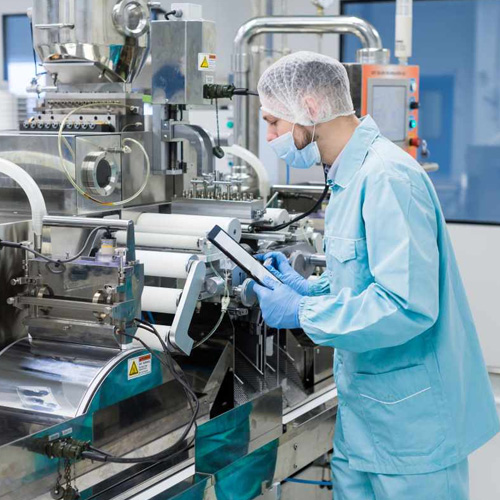
A vial powder filling and rubber stoppering machine is the aseptic-processing workhorse for any sterile powder injectable line. It doses a precise weight of sterile powder (antibiotic, lyophilized cake, API, vaccine, or biologic) into a sterile glass vial, then seats a sterile rubber stopper on top – all under ISO 5 / Grade A unidirectional airflow. Three dosing principles dominate pharmaceutical production:
- Auger Type – rotating helical screw in a tube, best for free-flowing to slightly cohesive powders (antibiotics, oral powders, APIs) at 50 mg – 50 g fill weight with +/- 0.5% accuracy. Throughput 30-200 VPM.
- Vacuum Type – negative-pressure dosing chamber, best for lyophilized cake reconstitution, micro-dose sterile fills, and cohesive powders at 5 mg – 5 g fill weight with +/- 1% accuracy. Throughput 30-120 VPM.
- Dosing-Disc Type – precision disc with machined cavities, best for very small doses (1 mg – 500 mg) of vaccine, biologic, or potent API at the highest accuracy (+/- 0.25%). Throughput 60-300 VPM.
All three configurations include integrated rubber stoppering in the same aseptic zone as filling. The machine is enclosed in an oRABS or cRABS with HEPA-filtered ISO 5 / Grade A laminar flow, sterile-filtered nitrogen blanketing for oxygen- and moisture-sensitive powders, and is built from SS 316L stainless steel with Ra <= 0.4 um contact surfaces, full CIP / SIP capability, and 21 CFR Part 11-ready control.
300
Vials / min (dosing disc)
+/- 0.25%
Highest dosing accuracy
1 mg
Lowest fill weight
ISO 5
Grade A aseptic zone
Auger Type Vial Powder Filling and Rubber Stoppering Machine
What it is and when to use it
The Auger Type Vial Powder Filling and Rubber Stoppering Machine uses a servo-driven helical screw rotating inside a SS 316L tube to meter a fixed volume of powder per revolution. The auger turns a precise number of steps (or a precise number of revolutions) to deliver a calibrated dose into the vial below. Output: up to 200 vials/min with +/- 0.5% dosing accuracy on free-flowing powders.
Use this machine when: your product is a free-flowing to slightly cohesive sterile powder such as a beta-lactam antibiotic, an oral powder for reconstitution, or a small-molecule API; fill weights are 50 mg – 50 g; and you need high throughput with proven auger technology.
Key Engineering Features
- Servo-driven auger metering: 2-8 auger dosing heads on a rotary indexing plate, each with a quick-change auger screw and a recipe-controlled step count for volume trim.
- Tool-free auger changeover: auger screws are released with a single lever and swapped in under 5 minutes for different fill weights or powder types.
- Powder hopper with agitation: SS 316L conical hopper with low-shear agitation to keep cohesive powders flowing; sterile-filtered nitrogen blanket to prevent oxidation.
- Integrated stoppering: vibratory bowl feeder orients sterile rubber stoppers; servo-driven pre-press head seats them to a recipe-defined depth.
- CIP / SIP ready: fully drainable auger tubes and product contact parts with spray-ball coverage and steam-sterilizable dosing heads.
- SS 316L contact parts: all wetted components in AISI 316L with Ra <= 0.4 um electropolished finish; FDA-grade silicone or EPDM seals.
- ISO 5 / Grade A aseptic zone: integrated laminar flow unit with H14 HEPA, airflow 0.36-0.54 m/s, full oRABS / cRABS enclosure with VHP decon port.
- 100% in-process check-weighing: load cell under each dosing station; out-of-spec vials are automatically rejected downstream.
- PLC + HMI control: Siemens / Allen-Bradley PLC, 10-15″ color touchscreen, recipe storage, fill-weight trending, alarm history, 21 CFR Part 11 audit trail.
Specifications – Auger Type
| Parameter | Specification |
|---|---|
| Throughput | 30–200 vials/minute, depending on vial format and fill weight |
| Vial Size Range | 2 ml–100 ml tubular glass vials conforming to ISO 8362-1 |
| Vial Diameter | 14 mm–52 mm |
| Vial Height | 30 mm–115 mm |
| Fill Weight | 50 mg–50 g per dosing head |
| Dosing Heads | 2–8 dosing heads, depending on the model |
| Dosing Accuracy | ±0.5% for free-flowing powders and ±1% for slightly cohesive powders |
| Auger Material | SS316L stainless steel with quick-change, tool-free auger replacement |
| Powder Hopper Volume | 5–25 litres with agitation and nitrogen blanketing |
| Product Path | SS316L stainless steel, finished to Ra ≤ 0.4 µm and suitable for CIP / SIP |
| Seals | FDA-grade silicone / EPDM seals, with PTFE available as an option |
| Stoppering | Vibratory bowl feeding with servo pre-press and adjustable stopper insertion depth |
| Stopper Sterilization | Autoclave-ready stopper loading or in-line SIP configuration |
| Aseptic Zone | ISO 5 / Grade A environment with H14 HEPA filtration and airflow velocity of 0.36–0.54 m/s |
| Barrier System | Open RABS or closed RABS with VHP decontamination port |
| Powder Transfer | Sterile split-butterfly valve or rapid transfer port from upstream equipment |
| Nitrogen Blanket | Sterile-filtered nitrogen with 99.99% purity at 0.2–0.5 bar |
| Power Supply | 415 V AC, 3-phase, 50–60 Hz |
| Power Consumption | 8–14 kW |
| Compressed Air | 5–7 bar oil-free compressed air, 200–400 litres/minute |
| Clean Steam for SIP | 2–3 bar saturated clean steam, 30–60 kg/hour |
| WFI for CIP | 2–3 bar, 200–500 litres/hour |
| Vacuum | Up to −0.8 bar, 30–50 m³/hour for stopper placement |
| Noise Level | ≤ 76 dB(A) |
| Machine Footprint | 3,400–4,800 mm L × 1,800–2,400 mm W × 2,300–2,700 mm H |
| Machine Weight | 2,800–5,200 kg |
| Warranty | 12 months comprehensive warranty with lifetime technical support |
Vacuum Type Vial Powder Filling and Rubber Stoppering Machine
What it is and when to use it
The Vacuum Type Vial Powder Filling and Rubber Stoppering Machine uses negative pressure to draw a fixed volume of powder into a precisely calibrated dosing chamber, then discharges the dose into the vial. The vacuum principle is gentle on cohesive, friable, or low-bulk-density powders and is ideal for lyophilized cake reconstitution (where the powder must not be compacted) and micro-dose sterile fills. Output: up to 120 vials/min with +/- 1% accuracy.
Use this machine when: your product is a lyophilized cake, a low-bulk-density cohesive powder, or a micro-dose sterile fill; you cannot tolerate auger-induced compaction or shear; or you need to dose a powder that flows poorly under gravity alone.
Key Engineering Features
- Vacuum dosing chamber: SS 316L chamber with adjustable depth (1-20 mm) for fine-tuning fill weight; recipe-controlled vacuum level and dwell time.
- Multi-head parallel dosing: 2-6 vacuum dosing heads on a rotary indexing plate, each with its own vacuum and discharge cycle.
- Gentle powder handling: no auger, no compaction, no shear – ideal for lyophilized cakes, freeze-dried vaccines, and friable APIs.
- Powder hopper with low-shear agitation: SS 316L conical hopper with gentle vibratory feed to keep cohesive powders flowing; sterile-filtered nitrogen blanket.
- Integrated stoppering: vibratory bowl feed, servo pre-press, depth adjustable. Same aseptic zone as filling.
- CIP / SIP ready: fully drainable dosing chamber and product contact parts with spray-ball coverage.
- SS 316L contact parts: all wetted components in AISI 316L with Ra <= 0.4 um; FDA-grade seals.
- ISO 5 / Grade A aseptic zone: integrated laminar flow unit with H14 HEPA, 0.36-0.54 m/s.
- 100% in-process check-weighing: load cell under each dosing station; out-of-spec vials rejected.
Specifications – Vacuum Type
| Parameter | Specification |
|---|---|
| Throughput | 30–120 vials/minute, depending on vial format and fill weight |
| Vial Size Range | 2 ml–100 ml tubular glass vials conforming to ISO 8362-1 |
| Fill Weight | 5 mg–5 g per dosing head |
| Dosing Heads | 2–6 dosing heads, depending on the model |
| Dosing Accuracy | ±1% of the set fill weight |
| Vacuum Level | −0.3 to −0.8 bar with closed-loop vacuum control |
| Dosing Chamber | SS316L stainless steel with adjustable dosing depth from 1 mm to 20 mm |
| Powder Hopper Volume | 5–25 litres with agitation and nitrogen blanketing |
| Product Path | SS316L stainless steel, finished to Ra ≤ 0.4 µm and suitable for CIP / SIP |
| Stoppering | Vibratory bowl feeding with servo pre-press and adjustable stopper insertion depth |
| Aseptic Zone | ISO 5 / Grade A environment with H14 HEPA filtration and airflow velocity of 0.36–0.54 m/s |
| Barrier System | Open RABS or closed RABS with VHP decontamination port |
| Nitrogen Blanket | Sterile-filtered nitrogen with 99.99% purity at 0.2–0.5 bar |
| Power Supply | 415 V AC, 3-phase, 50–60 Hz |
| Power Consumption | 8–13 kW |
| Compressed Air | 5–7 bar oil-free compressed air, 200–400 litres/minute |
| Clean Steam for SIP | 2–3 bar saturated clean steam, 25–50 kg/hour |
| WFI for CIP | 2–3 bar, 200–400 litres/hour |
| Vacuum Pump | Oil-sealed rotary vane vacuum pump with a capacity of 30–50 m³/hour |
| Noise Level | ≤ 76 dB(A) |
| Machine Footprint | 3,400–4,800 mm L × 1,800–2,400 mm W × 2,300–2,700 mm H |
| Machine Weight | 2,800–5,000 kg |
| Warranty | 12 months comprehensive warranty with lifetime technical support |
Dosing-Disc Type Vial Powder Filling and Rubber Stoppering Machine
What it is and when to use it
The Dosing-Disc Type Vial Powder Filling and Rubber Stoppering Machine uses a precisely machined SS 316L disc with cavities (drilled, EDM, or wire-EDM holes of a calibrated volume) rotating under a powder bed. Each cavity fills with powder by gravity and scraper blade, then discharges the dose into the vial below at the indexing station. The dosing disc is the gold standard for very small doses and the highest accuracy. Output: up to 300 vials/min with +/- 0.25% accuracy.
Use this machine when: you need the highest fill-weight accuracy on small doses (1 mg – 500 mg); your product is a vaccine, biologic, or potent API; or you need to dose a powder with very controlled particle size where auger shear is unacceptable.
Key Engineering Features
- Precision dosing disc: SS 316L disc with cavities of calibrated volume (0.1-500 mm³) drilled, EDM, or wire-EDM to +/- 0.001 mm tolerance. Quick-change design – under 10 minutes for a different fill weight.
- Multi-disc parallel dosing: 4-12 dosing discs on a rotary indexing plate, each with its own powder scraper and discharge cycle.
- Scraper-blade powder control: adjustable scraper ensures consistent cavity fill, even with cohesive or slightly variable powders.
- Powder hopper with low-shear agitation: SS 316L conical hopper with gentle vibratory feed; sterile-filtered nitrogen blanket.
- Integrated stoppering: vibratory bowl feed, servo pre-press, depth adjustable. Same aseptic zone as filling.
- CIP / SIP ready: fully drainable disc and product contact parts with spray-ball coverage.
- SS 316L contact parts: all wetted components in AISI 316L with Ra <= 0.4 um; FDA-grade seals.
- ISO 5 / Grade A aseptic zone: integrated laminar flow unit with H14 HEPA, 0.36-0.54 m/s.
- 100% in-process check-weighing: load cell under each dosing station; out-of-spec vials rejected.
Specifications – Dosing-Disc Type
| Parameter | Specification |
|---|---|
| Throughput | 60–300 vials/minute, depending on vial format and fill weight |
| Vial Size Range | 2 ml–50 ml tubular glass vials conforming to ISO 8362-1 |
| Fill Weight | 1 mg–500 mg per dosing disc |
| Dosing Discs | 4–12 dosing discs, depending on the model |
| Dosing Accuracy | ±0.25% of the set fill weight |
| Disc Cavity Volume | 0.1–500 mm³, calibrated to ±0.001 mm tolerance |
| Disc Material | SS316L stainless steel with quick-change, tool-free replacement |
| Disc Changeover | Under 10 minutes per vial format |
| Powder Hopper Volume | 3–15 litres with agitation and nitrogen blanketing |
| Product Path | SS316L stainless steel, finished to Ra ≤ 0.4 µm and suitable for CIP / SIP |
| Stoppering | Vibratory bowl feeding with servo pre-press and adjustable stopper insertion depth |
| Aseptic Zone | ISO 5 / Grade A environment with H14 HEPA filtration and airflow velocity of 0.36–0.54 m/s |
| Barrier System | Open RABS or closed RABS with VHP decontamination port |
| Nitrogen Blanket | Sterile-filtered nitrogen with 99.99% purity at 0.2–0.5 bar |
| Power Supply | 415 V AC, 3-phase, 50–60 Hz |
| Power Consumption | 7–12 kW |
| Compressed Air | 5–7 bar oil-free compressed air, 200–400 litres/minute |
| Clean Steam for SIP | 2–3 bar saturated clean steam, 25–50 kg/hour |
| WFI for CIP | 2–3 bar, 200–400 litres/hour |
| Noise Level | ≤ 75 dB(A) |
| Machine Footprint | 3,400–4,800 mm L × 1,800–2,400 mm W × 2,300–2,600 mm H |
| Machine Weight | 2,800–4,800 kg |
| Warranty | 12 months comprehensive warranty with lifetime technical support |
Auger vs Vacuum vs Dosing-Disc: Which Powder Filler Do You Need?
The pharmaceutical industry uses three principal aseptic powder-filling methods. The right choice depends on powder flow characteristics, fill weight, dosing accuracy and the validation burden your quality assurance team can support.
| Parameter | Auger | Vacuum | Dosing-Disc |
|---|---|---|---|
| Best For | Free-flowing to slightly cohesive powders, antibiotics and APIs | Lyophilized cakes, low-bulk-density powders and cohesive formulations | Vaccines, biologics, potent APIs and very small powder doses |
| Fill Weight Range | 50 mg–50 g | 5 mg–5 g | 1 mg–500 mg |
| Throughput | 30–200 vials per minute | 30–120 vials per minute | 60–300 vials per minute |
| Dosing Accuracy | ±0.5% for free-flowing powders and ±1% for cohesive powders | ±1% of the set fill weight | ±0.25% of the set fill weight |
| Powder Flow | Free-flowing to slightly cohesive powders | Cohesive, low-bulk-density and lyophilized powders | Free-flowing fine powders with controlled particle size |
| Shear / Compaction | Moderate due to auger-induced powder movement | Minimal, using controlled vacuum draw | Low, using gravity filling and scraper levelling |
| Capital Cost (USD) | $80K–$180K | $60K–$150K | $100K–$250K |
| Format Changeover | Approximately 5 minutes for auger replacement | Approximately 10 minutes for dosing-chamber depth adjustment | Approximately 10 minutes for dosing-disc replacement |
| Validation Burden | High: powder-flow studies, dust control and nitrogen-blanketing validation | High: vacuum-integrity testing and powder-flow validation | High: dosing-disc qualification and powder-flow validation |
| Common Downstream | Vial capping, inspection and labelling | Vial capping, inspection and labelling | Vial capping, inspection and labelling |
| Particle Performance | Excellent with validated closed-path dosing | Excellent with validated closed-path dosing | Excellent with validated closed-path dosing |
For free-flowing antibiotics and APIs in the 50 mg–50 g range, choose an auger filling system. For cohesive, low-bulk-density or lyophilized powders, choose a vacuum filling system. For vaccines, biologics and very small doses requiring the highest accuracy, choose a dosing-disc filling system.
Inside the Machine: 8-Stage Process
Each vial spends 2-8 seconds in the powder filler depending on format and number of stations. A typical 8-station process:
- Infeed indexing: sterile, depyrogenated vials from the cooling conveyor enter a star-wheel infeed and are indexed one-by-one into the dosing positions.
- No-vial detection: a photoelectric sensor confirms the vial is in position; if absent, the dosing cycle is skipped.
- Vial centering: centering fingers grip the vial body and align it precisely under the dosing head (auger tube exit, vacuum chamber outlet, or dosing disc cavity).
- Powder dosing: the dosing head (auger, vacuum, or disc) delivers a precise powder dose into the vial. For auger, the screw turns a calibrated number of steps. For vacuum, the chamber is evacuated and the dose drawn in. For disc, the disc indexes one position to discharge a calibrated cavity.
- Dose verification: a 100% in-process check-weighing load cell under the dosing station verifies the dose weight; out-of-spec vials are tagged for downstream reject.
- Needle / chamber withdrawal: the dosing head withdraws above the vial mouth as the star-wheel indexes to the next station.
- Stopper placement and pre-pressing: a vibratory bowl feeder orients a sterile rubber stopper; a gripper picks one stopper and places it on the vial mouth; a servo-driven pre-press head seats it to a recipe-defined depth (fully seated or pre-stop for lyophilization).
- Discharge: the filled, stoppered vial exits the aseptic zone to the capping machine conveyor. Out-of-spec vials (wrong dose, missing stopper) are automatically rejected.
Throughout the cycle, the controller logs fill weight (via in-process check scale), dosing head RPM or vacuum level, stopper depth, HEPA airflow, and air pressure to a 21 CFR Part 11 audit trail. The data is exported via Ethernet for batch records.
Aseptic Process Validation: A 5-Step How-To
Validation is the foundation of aseptic powder manufacturing. The following sequence is a practical, audit-tested approach used by our customers’ QA teams. It aligns with WHO TRS 986 Annex 2, EU GMP Annex 1 (2022), 21 CFR 211.94, FDA Process Validation Guidance (2011), and the relevant USP chapters.
Step 1 – Define user requirements and worst-case powder.
Document the smallest and largest vial formats, the lightest and heaviest fill weights, the worst-case powder (most cohesive, finest particle size, lowest bulk density), the target dosing accuracy, the air cleanliness (ISO 5 / Grade A), and the line speed. Lock these in a User Requirements Specification (URS) before ordering.
Step 2 – Execute IQ and OQ on the installed machine.
Run the IQ checklist (utilities, instrumentation, materials of construction, HEPA integrity, calibration) followed by OQ tests (no-vial dry cycle, alarm verification, sensor calibration, interlock function, gravimetric fill-weight verification at start / middle / end of cycle, powder flow rate mapping). Document deviations and resolutions.
Step 3 – Conduct placebo media fill (process simulation).
Run 2 consecutive shifts at production scale using placebo powder (e.g., lactose / mannitol blend) in place of product. After the placebo dose, reconstitute each vial with sterile growth medium (soybean-casein digest broth). Incubate at 20-25 degrees C for 7 days then 30-35 degrees C for 7 days. Confirm contaminated vials < 0.1% per EU GMP Annex 1. Repeat for 3 successful runs.
Step 4 – Perform environmental and personnel qualification.
Conduct viable and non-viable air monitoring, settle plates, contact plates, and active air sampling at the filling point during three media fills. Confirm Grade A (viable < 1 CFU/m³) and Grade B (viable < 10 CFU/m³) for the background. Qualify personnel through gowning and aseptic-technique requalification per Annex 1.
Step 5 – Run performance qualification (PQ) with three production batches.
Execute three consecutive production-scale batches of the actual product. Verify fill-weight accuracy per batch, stopper placement depth, environmental monitoring results, powder flow consistency, and 21 CFR Part 11 audit trail completeness. Issue the final validation report signed by QA, engineering, and production.
Estimated timeline: 6-8 weeks from IQ start to final report, depending on media-fill incubation. Estimated cost: $22,000 – $42,000 in QA, microbiology, and lab fees for a single product.
USP, EP, and Annex 1 Compliance
Every machine is engineered and documented against the following standards:
- USP <85> – Bacterial Endotoxin Test (LAL)
- USP <788> – Particulate Matter in Injections
- USP <789> – Particulate Matter in Ophthalmic Solutions
- USP <905> – Uniformity of Dosage Units
- USP <1207> – Container Integrity
- EP 2.9.19 – Particulate Contamination
- EP 2.6.14 – Bacterial Endotoxins
- EU GMP Annex 1 (2022) – Manufacture of Sterile Medicinal Products
- 21 CFR 211.94 – Drug Product Containers and Closures
- 21 CFR Part 11 – Electronic Records and Signatures
- FDA Process Validation Guidance (2011)
- WHO TRS 986 Annex 2 – WHO GMP for Pharmaceutical Products
- ISO 9001:2015 – Quality Management
- CE Machinery Directive 2006/42/EC
- ISPE Baseline® Guide – Sterile Product Manufacturing Facilities
Inline Integration with Tunnel and Capping
A vial powder filling and stoppering machine is rarely a standalone. It is the middle of a tightly synchronized aseptic line:
- Upstream: Vial unscrambler -> rotary gripper washer -> depyrogenation tunnel -> cooling conveyor
- Powder Filler: Automatic vial powder filling and rubber stoppering machine (auger / vacuum / dosing disc)
- Optional Lyophilizer: for pre-stoppered vials, the lyophilizer (freeze dryer) with auto-loading and final stoppering station
- Capping: aluminium cap sealing (if not done in the filler)
- Inspection: automated visual inspection for particles, cracks, fill weight, stopper presence, cap tightness
- Labeling: vial labeling machine with batch coding and serialization
Our powder fillers are designed for direct feed from our depyrogenation tunnels, with matched conveyor speed, pitch, and entry height. The exit feeds the capping machine conveyor with no operator handling between fill and cap.
Frequently Asked Questions
It is an integrated aseptic system that doses a precise weight of sterile powder into a sterile glass vial and seats a sterile rubber stopper on top – all under ISO 5 / Grade A unidirectional airflow. It is the workhorse of any sterile powder injectable line (antibiotic, lyophilized, vaccine, biologic).
Auger: best for free-flowing powders (50 mg – 50 g) with +/- 0.5% accuracy. Vacuum: best for lyophilized cakes, low-bulk-density, and cohesive powders (5 mg – 5 g) with +/- 1% accuracy. Dosing disc: best for very small doses (1 mg – 500 mg) of vaccine or biologic at +/- 0.25% accuracy.
Powder filling uses auger, vacuum, or dosing-disc principles and is highly sensitive to powder flow properties (angle of repose, bulk density, particle size, cohesion). It requires dust control, nitrogen blanketing, and a carefully balanced aseptic-zone airflow to keep particles out of the Grade A environment.
Auger: +/- 0.5% (free-flowing) to +/- 1% (cohesive). Vacuum: +/- 1%. Dosing disc: +/- 0.25%. All are validated per USP <905> with gravimetric verification and 100% in-process check-weighing.
Sterile powder is delivered in a closed, gamma-irradiated container and transferred under ISO 5 / Grade A airflow through a sterilizable split-butterfly valve or Rapid Transfer Port (RTP) into the filler’s dosing hopper, blanketed with sterile-filtered nitrogen.
A vibratory bowl feeder orients sterile rubber stoppers. A gripper picks one stopper per cycle, places it on the vial mouth, and a servo-driven pre-press head seats it to a recipe-defined depth. Pre-stoppered vials exit for capping; for lyophilized products, pre-stoppered vials enter a freeze dryer for final stoppering under vacuum.
ISO 5 / Grade A unidirectional airflow per EU GMP Annex 1 (2022) and USFDA aseptic-processing guidance. Powder filling is more challenging than liquid filling because powder particles become airborne during dosing – so the laminar flow must be carefully balanced.
Validation follows a 3-stage approach: IQ/OQ on the installed machine, placebo media fill with growth medium per Annex 1 (contaminated vials < 0.1%), and performance qualification with three production-scale batches. Powder path is swab-tested for microbial recovery.
415V AC 3-phase power, 8-15 kW connected load; 5-7 bar oil-free compressed air; clean steam for SIP; WFI for CIP; HEPA-filtered air for laminar flow; sterile-filtered nitrogen (99.99% purity) for powder blanketing; vacuum for powder transfer and stopper placement.
Powder filling doses a pre-made sterile powder. Lyophilization takes a liquid solution in a vial, freezes it, and removes water under vacuum to produce a powder cake inside the vial. A powder filler is used when the powder is supplied as a sterile bulk; a lyophilizer is used when the product is supplied as a liquid and must be dried in the vial.
Customer Outcomes
“We replaced our old volumetric cup filler with an auger-based powder filler for our beta-lactam antibiotic line. Fill-weight CV dropped from 1.8% to 0.32%, changeover between 500 mg and 1 g formats is under 8 minutes, and we passed three consecutive media fills on the first attempt.”
– Plant Director, Beta-Lactam Antibiotics Manufacturer, Hyderabad (reference available on request)
“The vacuum powder filler handled our lyophilized mAb cake at 12 mg per vial with +/- 0.8% accuracy – auger would have shattered the cake. N2 blanketing kept the moisture content below 0.5% throughout the run, and our QA team approved the PQ on the first submission.”
– Head of Manufacturing, Biologics CDMO, Boston, USA (reference available under NDA)
“Dosing-disc filler on our vaccine line gave us the +/- 0.18% accuracy we needed for a 50 ug antigen dose. Disc changeover for 1 mL and 2 mL formats is 7 minutes, and we run 280 VPM with 100% in-process check-weighing.”
– Production Head, Vaccine Manufacturer, Pune (reference available on request)
Installation, Validation, and Support
Every machine is delivered as a turnkey project with the following scope:
- Pre-shipment Factory Acceptance Test (FAT) at our facility, with fill-weight data, powder flow mapping, and CIP/SIP cycle logs
- On-site installation, commissioning, and Site Acceptance Test (SAT)
- IQ and OQ execution support, including protocol walkthrough with your QA team
- Operator, maintenance, and aseptic-technique training (typically 5 days)
- 1-year comprehensive warranty covering parts and labor
- Lifetime remote support via video call, TeamViewer, and WhatsApp business
- Annual Maintenance Contract (AMC) options including preventive maintenance, HEPA integrity testing, and recalibration
- Spare parts kits shipped within 24-48 hours globally from regional warehouses
Typical delivery times: Standard machines ship in 12-16 weeks; customized configurations in 16-22 weeks. Installation and validation typically add 4-6 weeks on site.

Industries We Serve
- Pharmaceutical and biopharmaceutical manufacturing
- Vaccine and biological manufacturing
- Lyophilized (freeze-dried) injectables
- Sterile antibiotic and beta-lactam manufacturing
- Veterinary antibiotics and injectables
- Contract development and manufacturing organizations (CDMOs)
Certifications and Compliance
- ISO 9001:2015 Certified Manufacturing
- CE Marking (Machinery Directive 2006/42/EC)
- cGMP-Compliant Design
- WHO-GMP Compatible
- USFDA-Ready Configurations
- EU GMP Annex 1 (2022) Compatible
Related Vial Processing Equipment
- Vial Washing Machine (/products/vial-washing-machine)
- Vial Depyrogenation Tunnel (/products/vial-depyrogenation-tunnel)
- Automatic Vial Filling and Rubber Stoppering Machine (/products/vial-filling-rubber-stoppering-machine)
- Vial Cap Sealing Machine (/products/vial-cap-sealing-machine)
- Vial Inspection Conveyor Booth (/products/vial-inspection-conveyor-booth)
- Vial Labeling Machine (/products/vial-labeling-machine)
Request a Free Quote
Get a customized quotation with full technical specifications, utility consumption estimate, validation plan, and line-layout proposal within 24 hours.
- Request a Quote
- +91 96012 74176
- Email Sales (mailto:info@pharmamachineryind.com)