- Product Overview
- Technical Specifications
- Key Features & Engineering Details
- Rotary vs Linear Labeling: When to Choose Rotary
- Pharmaceutical Applications
- GMP, WHO, and USFDA Compliance
- Optional Add-Ons and Line Integration
- Installation, Validation, and Support
- Frequently Asked Questions
- Customer Outcomes
- Request a Quote

What is a Rotary Bottle Labelling Machine?
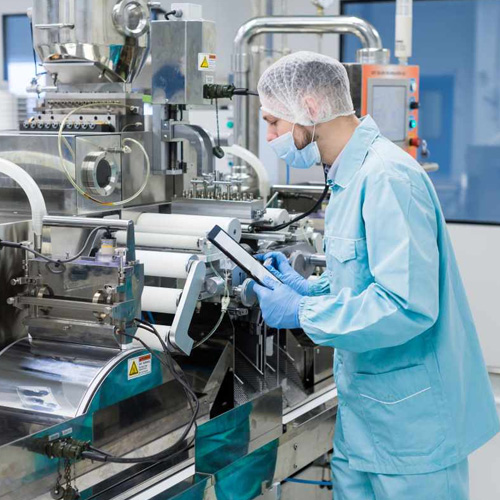
The High Speed Rotary Bottle Labeling Machine is an automatic, continuous-motion labeling system engineered for pharmaceutical packaging lines running above 150 bottles per minute. A servo-driven rotary star-wheel indexes bottles through the labeling station, where self-adhesive labels are dispensed, applied, and pressed with ±1 mm positional accuracy.
Every product-contact surface is fabricated from SS 304 or SS 316 stainless steel with a crevice-free, electropolished finish. The machine is qualified for use in WHO-GMP, cGMP, and USFDA-regulated production environments and is built to operate continuously for 24/7 shifts with an average Mean Time Between Failures (MTBF) exceeding 6,000 hours.
| Metric | Details |
|---|---|
| 400 | Bottles per minute peak production speed |
| ±1 mm | Label placement accuracy |
| 25+ | Countries with installed machines |
| 6,000 Hours | Average mean time between failures (MTBF) |
Technical Specifications
| Parameter | Specification |
|---|---|
| Machine Type | Automatic rotary bottle labeling machine with continuous-motion operation |
| Peak Throughput | Up to 400 bottles per minute, depending on the machine model and bottle format |
| Sustained Throughput (8-Hour Shift) | 280–360 bottles per minute for 30–100 ml bottle formats |
| Labeling Accuracy | ±1 mm across all operating speeds |
| Bottle Diameter Range | 20 mm–120 mm; customizable for bottles up to 200 mm in diameter |
| Bottle Height Range | 40 mm–300 mm |
| Label Roll Diameter | Up to 400 mm |
| Label Length | 20 mm–300 mm |
| Label Width | 15 mm–110 mm |
| Indexing System | Servo-driven rotary star-wheel indexing system with bottle-neck support |
| Power Supply | 230 V / 415 V AC, 3-phase, 50–60 Hz |
| Power Consumption | 2.5–4.5 kW |
| Air Pressure | 4–6 bar oil-free, filtered compressed air |
| Air Consumption | 120–180 litres per minute |
| Construction – Contact Parts | SS316 stainless steel as standard; SS304 stainless steel available as an option |
| Construction – Non-Contact Parts | SS304 stainless steel with an epoxy-coated mild-steel base frame |
| Surface Finish | Ra ≤ 0.8 µm with electropolished product-contact parts |
| Control System | Delta or Siemens PLC with a 7–10-inch colour HMI touchscreen |
| Servo Motor and Drive | Delta ECMA or Panasonic Minas A6 high-precision servo motor and drive system |
| Sensor Package | Product detection, label end-of-roll, low-label, broken-label and bottle-jam detection sensors |
| Safety Compliance | CE marked and designed according to EN 60204-1, with emergency stop, safety interlocks and an optional light curtain |
| Machine Footprint (L × W × H) | 2,200 × 1,400 × 1,800 mm for the standard model |
| Machine Weight | 850–1,500 kg, depending on the selected configuration |
| Noise Level | ≤78 dB(A) |
| Warranty | 12-month comprehensive warranty with lifetime technical support |
Key Features & Engineering Details
Choosing the right bottle washing machine depends on your daily output, water quality, and regulatory environment. Use this honest decision guide.
Pharmaceutical-Grade SS 304/316 Construction
All product-contact parts — the rotary star-wheel, bottle guides, label platens, and pressure rollers — are fabricated from AISI 316L stainless steel with a Ra ≤ 0.8 µm electropolished surface. This grade contains 2–3% molybdenum, which provides superior resistance to chloride-induced pitting and corrosion from cleaning agents such as sodium hypochlorite and isopropanol.
Welds are ground flush and passivated; there are no crevices, threaded fasteners, or sharp internal corners where product residue or cleaning agents can accumulate. The machine frame is SS 304, mounted on a powder-coated mild steel base for vibration damping. The result is a hygienic, audit-ready machine that passes WHO TRS 986 Annex 2 and FDA 21 CFR 211.63 equipment-cleanliness expectations.
Continuous-Motion Rotary Star-Wheel
Unlike intermittent-motion systems that stop the bottle during label application, this machine uses a continuous-motion star-wheel indexed by a high-precision servo. The bottle is held by its neck — not its base — which keeps the label-application plane stable and prevents scuffing on printed surfaces. The result is jerk-free throughput at 400 BPM with no measurable label-skew drift, even after 12-hour production runs.
Servo-Driven Label Dispensing Head
Label dispense is controlled by a dedicated servo motor and stepper drive pair, achieving a placement repeatability of ±1 mm across the full speed range. The dispensing head accepts self-adhesive paper, BOPP, transparent, foil, and partial- or full-wrap labels. A precision peel-plate angle (typically 30°) and a vacuum-assist label gripper eliminate flagging and wrinkling on transparent films — a common failure mode in cheaper units.
PLC + HMI Control with Recipe Management
The control architecture is built on a Delta DVP / Siemens S7-1200 PLC with a 7–10″ color HMI touchscreen. Operators interact with a single screen for:
- Recipe storage for up to 200 SKUs (label length, dispenser position, conveyor speed, registration offset)
- Live production counters (BPM, total count, reject count, OEE)
- Alarm history with timestamped fault codes
- Multi-level password access (operator / supervisor / engineer)
- Remote diagnostics via Ethernet / 4G (optional)
Most operators are fully trained in under 30 minutes thanks to icon-driven menus. Recipe changeover between saved SKUs takes less than 60 seconds.
Quick Changeover for Multiple SKUs
Changeover between bottle diameters and label sizes is tool-less: star-wheel pockets are swapped via a quick-release clamp, and guide rails are adjusted on graduated scales. A trained operator can complete a full size change in 8–15 minutes, making the machine economical for contract manufacturers running small batches across many SKUs.
Low Maintenance and High Availability
The modular design uses color-coded pneumatic lines, quick-disconnect fittings, and a self-diagnostic PLC that flags impending failures (e.g., servo overload trends, low air pressure, label end-of-roll). Critical spares — belts, sensors, label heads, and pneumatic cylinders — are stocked in regional warehouses for 24–48 hour dispatch worldwide.
Rotary vs Linear Labeling: When to Choose Rotary
Buyers often compare a rotary bottle labeler to a linear bottle labeler. The right choice depends on throughput target, product mix, and capital budget. The table below summarizes the practical differences.
| Parameter | Rotary Labeling Machine | Linear Labeling Machine |
|---|---|---|
| Typical Throughput | 150–400 bottles per minute | 40–120 bottles per minute |
| Changeover Time | 8–15 minutes, with tool-free changeover available on modern machines | 5–20 minutes, generally requiring more manual adjustments |
| Capital Cost | Higher investment, typically $25,000–$80,000 or more depending on the configuration | Lower investment, typically $8,000–$25,000 |
| Footprint | Larger footprint, generally 2.0–3.0 metres in length | Compact footprint, generally 1.2–2.0 metres in length |
| Best For | High-volume production lines, multiple SKUs, GMP plants and export-oriented manufacturing | Small-batch production, contract packaging and research and development lines |
| Label Placement Accuracy | ±1 mm at high operating speeds | ±1 mm to ±2 mm |
| Typical Industries | Large-scale pharmaceutical, FMCG, beverage and cosmetic manufacturing | Startups, Ayurvedic units and small contract-packaging companies |
Pharmaceutical Applications
This machine is qualified for labeling the following primary-pack formats:
- 💊 Syrup bottles and oral suspensions (30 ml – 1 L PET/glass)
- 💉 Injectables and small-volume parenterals (2 ml – 100 ml vials)
- 👁️ Ophthalmic drops, ear drops, and nasal sprays
- 🧴 Ointment tubes, jars, and topical containers
- 🌿 Ayurvedic and herbal preparations
- 💧 Distilled water, saline, and IV bottles
- 🧬 Nutraceuticals, soft-gel, and supplement containers
- 🧼 Antiseptic lotions, sanitizers, and disinfectant liquids
For non-round, oval, or square containers, the star-wheel is custom-engineered with format-specific pockets and a dual-roller pressing system.
GMP, WHO, and USFDA Compliance
Pharmaceutical buyers are not just buying a machine — they are buying a validation package. Every machine ships with:
- Material Test Certificates (MTC) for all SS 316 / SS 304 contact parts
- Surface roughness reports (Ra ≤ 0.8 µm)
- CE Declaration of Conformity
- Factory Acceptance Test (FAT) report
- DQ / IQ / OQ protocol templates
- Calibration certificates for critical sensors
- Operation & Maintenance Manual with illustrated parts list
- GMP inspection-friendly documentation
The machine design is aligned with the following standards and guidelines:
- WHO TRS 986, Annex 2 (WHO good manufacturing practices for pharmaceutical products)
- 21 CFR Part 211 (U.S. cGMP for finished pharmaceuticals)
- EU GMP EudraLex Volume 4, Annex 1 and Annex 15
- Schedule M (India) — good manufacturing practices and requirements of premises, plant, and equipment
- ISPE Baseline® Pharmaceutical Engineering Guide
- ISO 9001:2015 quality management
- CE Machinery Directive 2006/42/EC
Optional Add-Ons and Line Integration
| Add-On | Purpose | Compatible Brands |
|---|---|---|
| Online Inkjet Printer | Prints batch numbers, manufacturing and expiry dates, MRP and other variable product details | HP, Domino, EBS and Videojet |
| Automatic Bottle Feeding Conveyor with Rotary Accumulator | Provides continuous and controlled infeed of unsorted bottles to the labelling machine | In-house, Laner-Tech and Nerpac |
| Sleeve Applicator | Applies full-body shrink sleeves, neck sleeves and tamper-evident bands | Axon, Sidel and in-house systems |
| Vision-Based Label Inspection | Detects and automatically rejects skewed, missing, damaged or misprinted labels | Cognex, Keyence and SICK |
| Online Checkweigher | Verifies the filled product weight after labelling and rejects underweight or overweight bottles | Mettler Toledo, Ishida and Minebea Intec |
| Metal Detector | Detects ferrous, non-ferrous and stainless-steel contaminants in packaged products | Mettler Toledo, Eriez and Loma |
| Bottle Unscrambler or Turntable | Automatically sorts, orients and feeds bulk-loaded bottles into the production line | In-house systems |
| Cartoning Line Integration | Supports end-of-line carton loading, leaflet insertion, coding, closing and sealing operations | IMA, CAM, Romaco and in-house systems |
Installation, Validation, and Support
Every machine is delivered as a turnkey project. Our standard scope of supply includes:
Pre-shipment Factory Acceptance Test (FAT) at our facility
On-site installation and commissioning by a certified engineer
Operator and maintenance training (typically 2–3 days)
Site Acceptance Test (SAT), IQ, and OQ support
1-year comprehensive warranty covering parts and labor
Lifetime remote support via video call, TeamViewer, and WhatsApp business
Annual Maintenance Contract (AMC) options
Spare parts kits shipped within 24–48 hours globally
Frequently Asked Questions — Rotary Bottle Labelling Machine
Up to 400 bottles per minute in continuous operation. Sustained throughput over an 8-hour shift typically averages 280–360 BPM for 30–100 ml formats, depending on bottle geometry, label length, and material.
Rotary machines use a rotating star-wheel to index bottles past a stationary labeling head, supporting 150–400 BPM with smoother handling. Linear machines move bottles along a straight conveyor and typically cap out at 60–120 BPM, but they are simpler, cheaper, and adequate for low-volume or R&D production.
Yes. The machine is built with SS 304/316 contact parts, crevice-free fabrication, FDA-approved conveyor belts, and full validation documentation including DQ/IQ/OQ templates, MTCs, and a CE Declaration of Conformity.
Standard range: 20–120 mm bottle diameter and 20–300 mm label length on rolls up to 400 mm. Compatible label types include self-adhesive paper, BOPP, transparent, foil, and partial or full wrap-around labels. Non-round bottles require custom change parts.
Tool-less changeover for round bottle sizes takes 8–15 minutes for trained operators. Recipe recall from PLC memory is instant for repeat SKUs.
Yes. We provide on-site installation, commissioning, and operator training in India, Africa, the Middle East, Southeast Asia, Europe, and Latin America. Lifetime remote support is included.
Standard machines ship in 4–6 weeks. Customized configurations in 6–10 weeks. Spare parts ship within 24–48 hours from regional warehouses.
Yes. Modular integration with HP, Domino, and EBS inkjet printers, vision inspection systems, and aggregation software compliant with India’s DGFT, EU FMD, and U.S. DSCSA requirements.
Industries We Serve
- Pharmaceutical and biopharmaceutical manufacturing
- Ayurvedic, herbal, and traditional medicine
- Nutraceuticals and dietary supplements
- Cosmetics and personal care
- Food and beverages
- Chemicals and lubricants
- Veterinary medicines
Certifications and Compliance
- ISO 9001:2015 Certified Manufacturing
- CE Marking (Machinery Directive 2006/42/EC)
- GMP-Compliant Design
- WHO-GMP Compatible
- USFDA-Ready Configurations
- NSIC / MSME Registered (if applicable)
Request a Free Quote
Get a customized quotation with detailed specifications, ROI analysis, and line-layout proposal within 24 hours.