- What Is a Rotary Gripper Type Vial Washing Machine?
- How It Works: 8-Stage Wash Cycle Explained
- When Should You Use a Rotary Gripper Vial Washer?
- Key Engineering Features
- Technical Specifications
- Rotary Gripper vs External vs Ultrasonic vs Air-Jet
- Washing Cycle Validation: A 6-Step How-To
- USP, EP, and Annex 1 Compliance
- Inline Integration with Tunnel & Filling
- Frequently Asked Questions
- Installation, Validation, and Support
- Request a Quote

What Is a Rotary Gripper Type Vial Washing Machine?
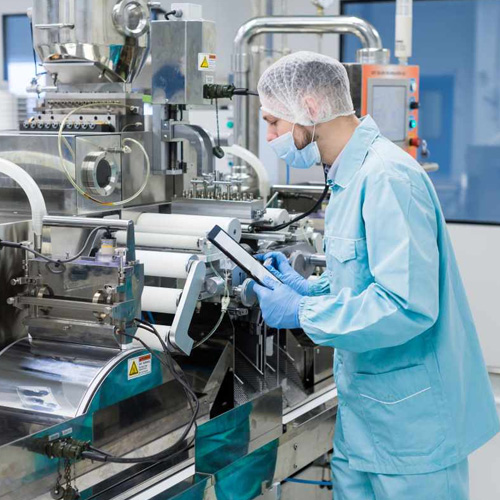
A rotary gripper type vial washing machine is the first critical step in any aseptic injectable line. It removes particulate, microbial, and endotoxin loads from incoming glass vials before they enter the depyrogenation tunnel and aseptic filling zone. The machine holds each vial inverted by the neck using polymer-lined gripper jaws mounted on a continuously rotating index plate, indexes it through 6 to 8 wash stations, and discharges a clean, dry, depyrogenation-ready vial at up to 300 vials/min.
The rotary gripper washer is the workhorse of WHO-GMP, EU Annex 1, and USFDA injectable lines because it does three things in one machine: (1) cleans the inside of the vial with recirculated wash + purified water + WFI, (2) cleans the outside with spray jets, and (3) dries the vial with HEPA-filtered air — all without operator handling and at validated cycle time.
- Internal + External Wash in a single indexed cycle — no need for a separate external pre-wash station.
- WFI Final Rinse with online conductivity and temperature monitoring — meets USP and EP water-quality expectations for parenterals.
- HEPA-Filtered Air Blow-Off at 0.3 µm leaves the vial surface dry and cooled — direct feed to depyrogenation tunnel without thermal shock.
- SS 316L Contact Parts with Ra ≤ 0.4 µm electropolished finish, fully drainable, no dead legs.
- Servo-Driven Indexing with cam-actuated gripper jaws — gentle, repeatable clamping force, breakage rate < 0.1%.
300
Vials / minute (max)
8
Wash stations
< 0.1%
Breakage rate
Ra ≤ 0.4 µm
Contact surface finish
How It Works: 8-Stage Wash Cycle Explained
A rotary gripper vial washer indexes each vial through a fixed sequence of stations. The standard 8-stage cycle is the most common configuration on parenteral injectable lines; 6-stage and custom sequences are available for specific product needs.
- Stage 1 — Infeed and inversion: Vials arrive on the infeed conveyor in the upright position. A star-wheel inverts them and transfers them, mouth-down, into the gripper jaws of the rotating index plate.
- Stage 2 — Pre-rinse with air injection: Purified water is sprayed into the inverted vial while pulsed air bubbles up through the water column. The bubbling action dislodges loosely adhered particles from the vial wall and base.
- Stage 3 — Internal recirculated wash: Recirculated purified water (typically 40–60 °C with a low-foaming detergent) is sprayed into the vial. The wash is captured, filtered, and reused across the cycle to limit consumption.
- Stage 4 — Internal purified water rinse: Fresh purified water rinses the recirculated wash residue from the vial wall. This is a one-pass rinse, not recirculated.
- Stage 5 — Internal WFI final rinse: WFI is sprayed into the vial. Final-rinse WFI is captured in a recirculating loop with online conductivity (≤ 1.3 µS/cm) and temperature (typically 70–80 °C) monitoring. Loop reduces WFI consumption by 30–40%.
- Stage 6 — External purified water spray: Spray jets outside the vial wash the side wall, shoulder, and base, removing any transport dust, fingerprints, or label-adhesive residue.
- Stage 7 — External WFI spray + HEPA-filtered air blow-off: A final WFI spray rinses the outside, followed by a HEPA-filtered air curtain (0.3 µm) that removes the water film.
- Stage 8 — Re-inversion and discharge: A second star-wheel re-inverts the vial to the upright position and transfers it to the discharge conveyor, which feeds the depyrogenation tunnel entry.
Total cycle time for one vial is typically 8–14 seconds depending on station count and indexing speed. The machine runs continuously, with the index plate making one full revolution per cycle.
When Should You Use a Rotary Gripper Vial Washer?
The rotary gripper vial washer is the right machine for the majority of bulk-vial injectable lines. Use it when all of the following are true:
- Vials arrive bulk and unsterilized in trays or bags (i.e., not pre-sterilized RTU vials).
- Downstream is a depyrogenation tunnel and aseptic filling line under ISO 5 / Grade A unidirectional airflow.
- Regulatory expectations include USP <788> particulate, USP <85> endotoxin, and cGMP equipment-cleanliness under 21 CFR 211.94.
- Throughput target is 60–300 vials/min (single machine).
- Vial format is tubular glass, 2 ml – 100 ml (larger sizes quoted as special executions).
Do not use a rotary gripper washer when:
- Vials arrive pre-sterilized in nests (RTU) — an external washer or no wash is sufficient; an internal wash on a pre-sterilized vial risks re-contamination.
- You are running small-batch clinical or stability samples — a manual or semi-automatic washer is more cost-effective.
- The vial is ampoule or cartridge format — those need a sealed-ampoule washer or a cartridge-specific line.
Key Engineering Features
- Gripper indexing system: servo-driven rotary plate with cam-actuated gripper jaws — gentle, repeatable clamping force, no glass-to-glass contact, breakage rate < 0.1%.
- 6–8 stage wash cycle: pre-rinse with air injection, internal recirculated wash, internal purified water rinse, internal WFI rinse, external purified water spray, external WFI spray, HEPA-filtered air blow-off, re-inversion and discharge.
- SS 316L contact parts: all wash-zone wetted components in AISI 316L with Ra ≤ 0.4 µm electropolished finish, fully drainable, no dead legs per ASME BPE.
- WFI recirculation loop: final rinse water captured in a recirculating loop with online conductivity (≤ 1.3 µS/cm) and temperature monitoring; reduces WFI consumption by 30–40%.
- Inline tunnel interface: discharge conveyor mates directly to depyrogenation tunnel entry at matched speed and pitch, with no operator handling.
- PLC + HMI control: Delta / Siemens PLC, 7–10″ color touchscreen, recipe storage for vial formats, alarm history, 21 CFR Part 11-ready audit trail.
- Safety and access: CE marked per EN 60204-1, full guarding, interlocked doors, emergency stops, and a one-touch shutdown sequence that drains the wash zone in under 90 seconds.
- Quick format change: tool-free changeover of gripper jaws, needle track, and star-wheels in 20–40 minutes per format. Recipes stored on HMI.
- Spray manifold verification: each spray nozzle is documented with a flow-vs-pressure curve; pressure transmitters on purified water and WFI manifolds trigger alarms if drift exceeds ±5%.
- Drainability: wash cabinet sloped ≥ 1:60 to a central trough; no pooling per FDA and EMA process-equipment guidance.
Technical Specifications
| Parameter | Specification |
|---|---|
| Throughput | 60–300 vials/minute, depending on vial format |
| Vial Size Range | 2 ml–100 ml tubular glass vials conforming to ISO 8362-1 |
| Vial Diameter | 14 mm–52 mm |
| Vial Height | 30 mm–115 mm |
| Wash Stations | 6–8 configurable washing stations |
| Wash Coverage | Internal and external vial washing |
| Indexing System | Servo-driven rotary plate with cam-operated gripper mechanism |
| Cycle Time per Vial | 8–14 seconds |
| Contact Parts | SS316L stainless steel, electropolished to Ra ≤ 0.4 µm |
| Non-Contact Frame | SS304 stainless steel with epoxy-coated MS base |
| Water Pressure | 1.5–3 bar for purified water and WFI |
| WFI Consumption | 5–8 ml per vial for 10 ml vial format with 8 washing stations |
| Purified Water Consumption | 200–400 litres/hour |
| WFI Loop Conductivity | ≤ 1.3 µS/cm with online monitoring |
| WFI Loop Temperature | 70–80°C with online monitoring |
| Compressed Air | 4–6 bar oil-free compressed air, 150–200 litres/minute |
| HEPA-Filtered Air | ISO 5 / Grade A air supply with 0.3 µm HEPA filtration |
| Power Supply | 230 V / 415 V AC, 3-phase, 50–60 Hz |
| Power Consumption | 3.0–5.0 kW |
| Noise Level | ≤ 76 dB(A) |
| PLC | Delta / Siemens S7-1200 / Siemens S7-1500 |
| HMI | 7-inch to 10-inch colour touchscreen |
| Data Logging | 21 CFR Part 11-ready audit trail with Ethernet / LAN connectivity |
| Machine Footprint | 2,400 × 1,600 × 1,900 mm for a typical 8-station model |
| Machine Weight | 1,200–2,000 kg |
| Vial Breakage Rate | Less than 0.1% with a calibrated gripper and correct vial format |
| Warranty | 12 months comprehensive warranty with lifetime technical support |
Rotary Gripper vs External vs Ultrasonic vs Air-Jet: Which Washer Do You Need?
The pharmaceutical industry uses four principal vial-washing approaches. The right choice depends on the incoming vial condition, downstream aseptic requirements and the validation burden your quality assurance team can support.
| Parameter | Rotary Gripper | External Washer | Ultrasonic | Air-Jet (Vacuum) |
|---|---|---|---|---|
| Wash Coverage | Internal + External | External only | Internal + External | Internal only |
| Throughput (VPM) | 60–300 | 100–400 | 30–120 | 60–200 |
| WFI Final Rinse | Yes, standard | Optional | Yes, optional | No, air cleaning only |
| Air Blow-Off | HEPA-filtered air, 0.3 µm | Air knife | Air knife | Vacuum + compressed air |
| Direct Tunnel Interface | Yes, with matched speed and vial pitch | Not typical | Not typical | Yes, with matched speed and vial pitch |
| Breakage Rate | < 0.1% | < 0.05% | < 0.5% due to possible cavitation stress | < 0.1% |
| Capital Cost (USD) | $32K–$95K | $18K–$45K | $45K–$110K | $25K–$70K |
| Validation Burden | Moderate: six-stage IQ/OQ/PQ validation | Low: three-stage IQ/OQ validation | High: cavitation performance and detergent validation | Low: no purified-water or WFI loop |
| Best For | Bulk unsterilized vials feeding a depyrogenation tunnel and aseptic filling line | Pre-sterilized RTU vials and cosmetic external pre-washing | Heavily soiled vials and recovery or reprocessing of rejected vials | Dry-cleaned vials and pre-washing for lyophilized product lines |
| Footprint | 2.4 m × 1.6 m | 1.8 m × 0.9 m | 2.6 m × 1.4 m | 1.8 m × 1.0 m |
| Industry Adoption | Standard on parenteral manufacturing lines | Common on RTU vial lines | Niche due to higher validation costs | Niche, mainly used for cosmetic or dry-cleaning applications |
If your vials arrive in bulk, are unsterilized and feed directly into a depyrogenation tunnel, a rotary gripper washer is the standard choice. For pre-sterilized RTU vials supplied in nests, an external washer is generally sufficient. For fast cosmetic pre-cleaning on a non-sterile production line, an air-jet vacuum cleaner is usually the fastest and simplest option.
Washing Cycle Validation: A 6-Step How-To
Washing cycle validation is governed by USP <788> (particulate), USP <85> (endotoxin), 21 CFR 211.94 (container cleanliness), and the process-equipment guidance in ICH Q7 and EU GMP Annex 1. The following sequence is a practical, audit-tested approach used by our customers’ QA teams.
Step 1 — Define user requirements and wash scope
Document the vial formats (2 ml – 100 ml tubular glass), the wash scope (internal + external, with WFI final rinse), the target throughput (60–300 VPM), the cleanliness target (USP <788> particulate, USP <85> endotoxin), and the background room grade (ISO 7 / Grade C). Lock these in a User Requirements Specification (URS) before ordering.
Step 2 — Execute IQ on the installed machine
Run the IQ checklist: utilities (power, compressed air, purified water, WFI supply and return), instrumentation calibration, materials of construction (SS 316L contact parts with Ra ≤ 0.4 µm), HEPA integrity on the air blow-off, and safety-circuit verification. Document all deviations and resolutions.
Step 3 — Execute OQ on wash cycle performance
Run the OQ tests: wash cycle timing at each station, spray pressure verification (1.5–3 bar on purified water and WFI), WFI loop conductivity and temperature trending, alarm and interlock verification, drainability of the wash cabinet, gripper jaw clamping force, and breakage rate challenge.
Step 4 — Perform cleaning verification
Use worst-case vials (longest hold time, highest particulate load) and run three consecutive wash cycles. Collect TOC swab and final-rinse samples at the discharge. Acceptance: TOC rinse ≤ 500 ppb (or as per internal SOP), no visible particles, endotoxin on the WFI loop ≤ 0.25 EU/ml.
Step 5 — Run performance qualification (PQ) with three production batches
Run three consecutive production batches through the washer and downstream tunnel + filling line. Verify wash-cycle consistency, vial defect rate, breakage rate, WFI consumption, and 21 CFR Part 11 audit trail completeness. Compare to historical manual or semi-automatic wash data for trending.
Step 6 — Compile the validation report and ongoing monitoring plan
Issue the final validation report signed by QA, engineering, and production. Define ongoing monitoring: periodic WFI loop conductivity and endotoxin trending, gripper jaw replacement schedule, HEPA replacement cadence, and revalidation triggers (format change, media change, major overhaul).
Estimated timeline: 4–6 weeks from IQ start to final report, depending on format count and PQ batch availability. Estimated cost: $12,000 – $25,000 in QA and lab fees for a single vial format.
USP, EP, and Annex 1 Compliance
Every machine is engineered and documented against the following standards:
- USP <788> — Particulate Matter in Injections
- USP <85> — Bacterial Endotoxin Test (LAL)
- USP <1230> — Water for Pharmaceutical Purposes
- USP <1116> — Microbiological Control of Aseptic Processing Environments
- EP 2.9.19 — Particulate Contamination (sub-visible)
- EP 2.9.20 — Visible Particles
- EU GMP Annex 1 (2022) — Manufacture of Sterile Medicinal Products
- 21 CFR 211.94 — Drug Product Containers and Closures
- 21 CFR 211.63 — Equipment Design and Construction
- 21 CFR Part 11 — Electronic Records and Signatures
- WHO TRS 986 Annex 2 — WHO GMP for Pharmaceutical Products
- ICH Q7 — GMP for Active Pharmaceutical Ingredients
- ASME BPE-2019 — Bioprocessing Equipment (for sanitary design)
- ISO 9001:2015 — Quality Management
- CE Machinery Directive 2006/42/EC
Inline Integration with Tunnel & Filling
A rotary gripper vial washer is the first machine on a parenteral injectable line:
- Upstream: Vial unscrambler or tray unloader (manual or automatic)
- Washer: Rotary gripper type vial washing machine (this product)
- Downstream: Vial depyrogenation tunnel → cooling conveyor → automatic vial filling and rubber stoppering machine → vial cap sealing machine → vial inspection conveyor booth → vial labeling machine
The washer’s discharge conveyor is designed for direct feed to a depyrogenation tunnel entry at matched speed and pitch, with no operator handling between wash and tunnel. The HEPA-filtered air blow-off at the washer exit leaves the vial surface dry and cooled enough to enter the tunnel’s pre-heat zone without thermal shock. Our washers integrate with both our own depyrogenation tunnels and major third-party tunnel brands.
Frequently Asked Questions
A rotary gripper type vial washing machine is an automatic pharmaceutical washer that holds each glass vial inverted by the neck using polymer-lined gripper jaws mounted on a continuously rotating index plate. As the plate indexes through 6–8 washing stations, each vial receives internal rinses, external sprays, a WFI final rinse, and HEPA-filtered air blow-off. It is the workhorse of parenteral and lyophilized injectable lines, capable of cleaning 60–300 vials/min with breakage below 0.1%.
A rotary gripper washer cleans both the inside and the outside of the vial using needles, jets, and a WFI final rinse, then HEPA-blows the vial dry before tunnel entry. An external washer cleans only the outside using rotating brushes and spray jets and is typically used for ready-to-use (RTU) pre-sterilized vials or as a coarse pre-wash. The rotary gripper is the machine of choice when bulk unsterilized vials are feeding a depyrogenation tunnel and aseptic filling line.
A typical rotary gripper vial washer has 6 to 8 wash stations, configured as: pre-rinse with air injection, internal recirculated wash, internal purified water rinse, internal WFI final rinse, external purified water spray, external WFI spray, HEPA-filtered air blow-off, and re-inversion and discharge. For lyophilized products, an extra WFI recirculation loop is often added to keep final-rinse conductivity below 1.3 µS/cm.
On a correctly formatted and maintained rotary gripper vial washer, breakage is consistently below 0.1% of vials processed. The gripper jaws are polymer-lined (typically FDA-grade EPDM or silicone) and apply a calibrated clamping force on the vial neck — never on the side wall. Breakage rises if the format change is incomplete, if a gripper jaw is worn, or if vials fall outside the supported diameter or height range.
415V AC three-phase power at 50–60 Hz, 3.0–5.0 kW connected load; purified water and WFI at 1.5–3 bar with a 5–8 ml/vial WFI consumption (10 ml format, 8 stations); 4–6 bar oil-free compressed air at 150–200 L/min for actuators and blow-off; HEPA-filtered air supply from the room HVAC (or an integrated blower) at 0.3 µm. No clean steam or nitrogen is required. Ethernet / LAN is recommended for batch data logging and 21 CFR Part 11 audit trail.
Standard formats cover 2 ml to 100 ml tubular glass vials (ISO 8362-1), with vial diameter 14 mm – 52 mm and vial height 30 mm – 115 mm. Format change typically takes 20–40 minutes and is recipe-driven on the HMI: change the gripper set, the needle track, the star-wheel pitch, and the infeed / outfeed guides. Most machines can be quoted to handle larger moulded vials (up to 500 ml) as a special execution.
Validation follows a 6-step process: URS, IQ, OQ (wash cycle timing, spray pressure, WFI loop conductivity, drainability, gripper force, breakage challenge), cleaning verification (TOC + endotoxin on worst-case vials), PQ with three production batches, and ongoing monitoring of WFI loop, gripper wear, and HEPA cadence.
An export-grade rotary gripper vial washing machine with 6–8 stations, SS 316L contact parts, WFI final rinse, HEPA air blow-off, and full IQ/OQ documentation is typically priced in the USD 32,000 – 95,000 range, depending on throughput (60–300 VPM), automation level, and validation package. Freight, installation, validation, and operator training are usually quoted separately. Request a formal quote to lock in configuration, lead time, and the IQ/OQ template.
Yes — the discharge conveyor of a rotary gripper vial washer is designed to mate directly to the entry of a hot-air depyrogenation tunnel. Speed, pitch, and entry/exit height are matched so that no operator handling is required between the washer and the tunnel. The HEPA-filtered air blow-off at the washer exit leaves the vial surface dry and cooled enough to enter the tunnel’s pre-heat zone without thermal shock.
Standard machines ship in 8–12 weeks from purchase order; custom executions in 14–18 weeks. The machine carries a 12-month comprehensive warranty covering parts and labour, with lifetime remote support via video call, TeamViewer, and WhatsApp business. Annual Maintenance Contracts (AMC) are available including preventive maintenance, format change support, and validation document refresh.

Customer Outcomes
“We replaced three manual wash stations with a single 8-station rotary gripper washer running 240 vials/min. Breakage dropped from 1.2% to under 0.05%, and the WFI loop reduced our final-rinse water consumption by 35%. The HMI recipes make format changeover a 25-minute job instead of a half-day.”
— Plant Manager, Generics Injectables Manufacturer, Hyderabad (reference available on request)
“Our old washer was the bottleneck on a 12,000 VPM vaccine line. The 300 VPM rotary gripper we installed dropped the floor footprint, integrated directly with our depyrogenation tunnel, and the IQ/OQ template shaved 3 weeks off validation. The FDA pre-approval inspection had no observations on the wash step.”
— Head of Engineering, Vaccine Manufacturer, Pune (reference available under NDA)
“Lyophilized powder vials are unforgiving on residual endotoxin. The HEPA blow-off and WFI recirculation loop on this washer gave us the consistent final-rinse conductivity we needed to pass USP <85> on every batch for 18 months running.”
— Director of QA, Biologics CDMO, Bangalore (reference available on request)
Installation, Validation, and Support
Every machine is delivered as a turnkey project with the following scope:
- Pre-shipment Factory Acceptance Test (FAT) at our facility, with wash-cycle timing verification, spray pressure challenge, and WFI loop conductivity and temperature trending
- On-site installation, commissioning, and Site Acceptance Test (SAT)
- IQ and OQ execution support, including protocol walkthrough with your QA team
- Operator and maintenance training (typically 3–5 days)
- 1-year comprehensive warranty covering parts and labour
- Lifetime remote support via video call, TeamViewer, and WhatsApp business
- Annual Maintenance Contract (AMC) options including preventive maintenance, format change support, WFI loop sanitization, and validation document refresh
- Spare parts kits shipped within 24–48 hours globally from regional warehouses
Typical delivery times: Standard machines ship in 8–12 weeks; custom executions in 14–18 weeks. Installation and validation typically add 3–6 weeks on site.
Industries We Serve
- Pharmaceutical and biopharmaceutical manufacturing
- Vaccine and biological manufacturing
- Lyophilized (freeze-dried) injectables
- Sterile ophthalmic and nasal sprays
- Veterinary injectables
- Contract development and manufacturing organizations (CDMOs)
Certifications and Compliance
- ISO 9001:2015 Certified Manufacturing
- CE Marking (Machinery Directive 2006/42/EC)
- cGMP-Compliant Design
- WHO-GMP Compatible
- USFDA-Ready Configurations
- EU GMP Annex 1 (2022) Compatible
Related Vial Processing Equipment
Vial Washing Machine (Parent) (/products/vial-washing-machine)
External Vial Washing Machine (/products/external-vial-washing-machine)
Vial Depyrogenation Tunnel (/products/vial-depyrogenation-tunnel)
Automatic Vial Filling & Stoppering Machine (/products/vial-filling-rubber-stoppering-machine)
Vial Powder Filling Machine (/products/vial-powder-filling-machine)
Vial Cap Sealing Machine (/products/vial-cap-sealing-machine)
Vial Inspection Conveyor Booth (/products/vial-inspection-conveyor-booth)
Vial Labeling Machine (/products/vial-labeling-machine)
Request a Rotary Gripper Vial Washer Quote
Tell us your vial format, throughput target, and tunnel integration. We will reply with a configured quotation, lead time, and IQ/OQ template within one business day.
- Request Quote (/quote/rotary-gripper-vial-washing-machine)
- Talk to an Engineer (/96012 74176)
Pharmaceutical Vial Washing Machines. WHO-GMP, EU Annex 1, USFDA compliant. Exporting to 25+ countries.