Match the Bottle Labeling Machine to the Label Layout
Buying a bottle labeling machine is easier when you can show how the finished pack should look. A round bottle may need a label wrapped around its body. A flat bottle may need one label on the front or separate labels on both faces. Each job needs a suitable handling setup.
Trouble often starts when two packs share the same volume but have different shapes. The machine may feed both bottles, yet place one label at an angle or on the wrong face. Bottle samples and the actual label rolls help reveal those limits before you place an order.
This guide helps you match the machine to the bottle, check the label supply and review a trial. You will also learn what to include in a bottle labeling machine quotation, so the offer covers the packs you plan to sell and the work your packaging line needs.
Round Bottle Labeling Machines and Wrap Around Labels
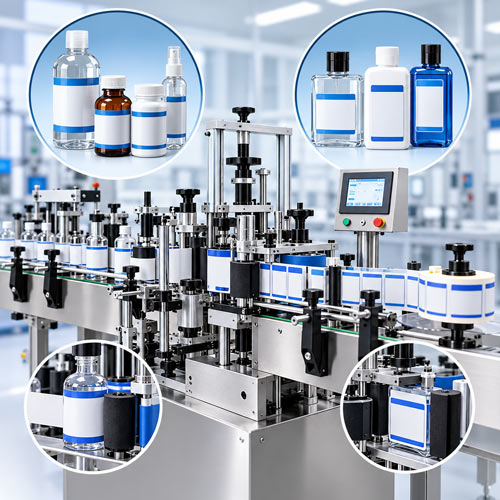
A round bottle labeling machine must control how the bottle turns while the label is applied. For a wrap around label, the bottle rotates as the label is pressed onto its body. The label may cover part of the surface or go around most of it.
Look closely at the area that will carry the label. A straight cylinder and a bottle that narrows toward the shoulder need different reviews. A bottle can look round from above while its sides change shape along the label height.
Decide where the label should start and end. Explain whether the ends need a gap or an overlap. If the label must line up with a moulded mark, handle or other feature, make that requirement clear.
When requesting a wrap around labeling machine, show the complete artwork on a bottle. That gives the supplier a better view of the job than a loose label alone.
For bottles with two separate labels, discuss how both will be positioned. One label around the body and two separate face labels are different layouts, even when the container is round.
Flat Bottle Labeling Machines Need Control of the Bottle Face
A flat bottle labeling machine needs to present the correct face to the label applicator. An applicator is the unit that releases and places the label. If the bottle turns or leans during travel, the label may land at an angle or on the wrong panel.
Single face labeling and front and back labeling should be quoted as separate requirements. Describe the size and position of each label. The front and back artwork may have different dimensions.
Oval bottles also deserve a careful review. Their broad faces may be curved rather than fully flat. Show the supplier where the label should sit and whether its edges approach a rounded corner.
| Bottle and label layout | Machine arrangement to discuss | Main point to prove in a trial |
|---|---|---|
| Round bottle with a body label | Wrap around application | Controlled turning and the agreed label end position |
| Flat bottle with one face label | Single face application with bottle alignment | Correct face and level placement |
| Flat or oval bottle with front and back labels | Application to both required faces | Stable handling and placement of both labels |
Some equipment can support more than one arrangement with the right modules and parts. Get written confirmation for your own formats before treating one machine as suitable for both round and flat bottles.
Bottle Labeling Machine Specifications Should Describe Each Pack
Useful bottle labeling machine specifications connect the bottle drawing to the label drawing. Build one record for each pack, including packs planned for later release.
Use dimensions from the real components. Bottle volume, such as 100 ml, tells the supplier little about the space available for a label.
| Detail | Information for the machine enquiry |
|---|---|
| Bottle shape | Drawing, material, overall size and label panel |
| Bottle condition | Empty or filled, capped or uncapped, and surface condition |
| Label layout | Number of labels, artwork and target position |
| Label construction | Paper or film, adhesive and backing material |
| Label roll | Label dimensions, gap, roll size, core size and unwind direction |
| Production need | Required formats, output and connection to nearby equipment |
The backing strip that carries the labels is often called the liner. Its size and construction are part of the roll specification. Unwind direction describes how the artwork faces as the roll feeds.
Have the label printer and machine supplier agree on a roll drawing. It should show the label orientation and which edge reaches the bottle first. This helps prevent a printable design from becoming an awkward roll to use on the selected applicator.
Supply bottles and label rolls that represent production. Keep the pack names consistent across the enquiry, samples and supplier proposal.
Label Material and Bottle Surface Affect Adhesion
The machine places the label, but the adhesive must suit the bottle surface and the conditions it will face.
Tell the label supplier whether the bottle is glass or plastic, and identify the actual material. Describe moisture, product residue or other surface conditions that may be present at labeling.
A sample applied to a dry bottle on a desk may behave differently from a pack on the production line. Include the expected conditions in the assessment rather than judging only the first neat result.
Soft bottles can change shape when handled. Their label material, adhesive and support during application need a joint review. Wrinkles may involve the bottle as well as the machine setting.
Transparent labels also need a suitable label sensing arrangement. Ask the machine supplier to demonstrate reliable dispensing with your actual roll.
This guide focuses on adhesive labels supplied on a backing roll. If your pack uses a sleeve or labels that need separate glue, state that early. It changes the equipment requirement.
Define Label Placement Before Comparing Accuracy Claims
A statement about labeling accuracy needs a clear reference. Decide what will be measured and how your team will judge the finished bottle.
You might measure the label height from the bottle base, its angle on a flat face, or the position of the ends on a round bottle. Select the checks that matter to your artwork and pack.
Keep print position and label application separate. A label may sit correctly on the bottle while its printed text is off centre within the label.
Prepare an approved example or a marked drawing. State the permitted variation with your packaging and quality teams. The supplier can then review whether its proposed setup can meet that requirement.
Avoid choosing an accuracy figure simply because it appears in a brochure. Have the supplier show how the claimed result applies to your bottle, label and running conditions.
Test a Bottle Labeling Machine with the Packs You Will Sell
A useful demonstration should answer the open questions about your pack. Choose the formats that present different challenges, such as a narrow round bottle, a soft flat bottle or a clear label.
Agree on the trial contents before sending samples. Specify whether the bottles should be filled and capped, and use a suitable representation of the real pack.
Follow a simple review sequence:
- Identify the bottle and label roll used for each run.
- Observe feeding, application and the finished label position.
- Review the selected formats after the required adjustments.
- Keep results and unresolved points with the proposed machine details.
Observe more than the first bottle. Watch for changes during the run, after a roll reload and after returning to a previous format. Your team should decide the trial length and number of samples needed.
Use visible problems to guide the next check. They can have several causes, so treat the following as starting points for a joint investigation.
| Problem seen | What to review before accepting the setup |
|---|---|
| Label is slanted | Bottle alignment, stability, label feeding and application settings |
| Wrinkles or bubbles | Bottle shape, label suitability, trapped air and how the label is pressed |
| Label edge lifts later | Adhesive choice, surface condition and the agreed use conditions |
| Labels feed incorrectly | Roll construction, web path and sensor suitability |
| Label appears on the wrong face | Bottle orientation and the reference used for placement |
Keep examples of unacceptable results as well as acceptable ones. Record the changes made and repeat the relevant checks. This gives your team a reason to accept the revised setup.
Include any required print or label inspection in the demonstration. A label presence check does not prove that the correct artwork or readable code is on the bottle. Define the function you need and have it demonstrated.
Automatic Bottle Labeling Machines Must Fit the Line
An automatic bottle labeling machine should work with the flow of bottles around it. Share the output of the nearby equipment and describe how bottles enter and leave the labeling section.
Review conveyor connections, bottle spacing and access for loading label rolls. A machine that fits the room still needs space for operators to reload, clean and service it.
Ask what happens when bottles stop arriving or build up at the exit. Agree on the signals and responses needed between machines.
Check the running output with each selected bottle and label layout. Front and back labels, inspection or coding may change what the complete arrangement can deliver.
For separate batch work, consider who loads bottles, removes finished packs and handles rolls. Include those tasks when judging the production plan.
Confirm the power and any air supply for the proposed setup. Use the supplier’s layout and utility details when preparing the site.
Compare Bottle Labeling Machine Price by the Included Work
Bottle labeling machine price depends on the equipment selected for the job. The offer may cover a basic application unit or a wider arrangement with bottle handling, several label heads, coding and inspection.
Set up your quotation comparison using a shared list of requirements. Mark each item as included, optional or awaiting clarification.
Pay particular attention to these areas:
- Application method for every round and flat bottle format
- Parts needed to guide and support each bottle
- Label dispensing and sensing for the selected rolls
- Printing, inspection and handling of rejected packs
- Conveyor connections, operator training and supplied documents
- Installation responsibilities and the terms of support
A combined round and flat bottle labeling machine may require extra equipment or format parts. Ask the supplier to identify those additions rather than relying on a general statement about flexibility.
Request the total for the agreed package, with taxes, transport and other quoted charges clearly stated. Check payment terms, delivery commitments and warranty coverage in the commercial offer.
An itemised proposal makes it easier to see which work your team would otherwise need to arrange after purchase.
Keep examples of unacceptable results as well as acceptable ones. Record the changes made and repeat the relevant checks. This gives your team a reason to accept the revised setup.
Include any required print or label inspection in the demonstration. A label presence check does not prove that the correct artwork or readable code is on the bottle. Define the function you need and have it demonstrated.
Request a Bottle Labeling Machine Quote in India
Pharma Machinery India lists wrap around labeling machines for round bottles and flat bottle labeling equipment, including front and back arrangements. Its contact office is in Ahmedabad, Gujarat.
Review the wrap around labeling machine range for a round body label. For face labels, review the flat bottle labeling machine range.
When contacting a bottle labeling machine supplier in India, attach the pack records, artwork and roll drawings you have prepared. Describe the formats required now and those planned later.
Ask for a proposal that explains the suggested handling and application arrangement. Use the Pharma Machinery India contact page or call +91 96012 74176 to start the technical and quotation discussion.
Conclusion Choose the Labeling Setup Your Pack Needs
The best starting point for buying a bottle labeling machine is a clearly defined pack. Show the bottle shape, the label layout and the roll construction together.
Use actual samples to examine alignment, dispensing and adhesion. Agree how the finished result will be judged, then make sure the quotation covers the equipment and work needed to achieve it.
Share those details with Pharma Machinery India to discuss a suitable machine for your round or flat bottles.
Bottle Labeling Machine Buying FAQs
For a body label that follows the bottle’s curve, discuss a wrap around labeling machine. Share the bottle drawing, artwork and roll details. Explain whether the label needs a gap, an overlap or alignment to a bottle feature. Confirm the result with samples before selecting the setup.
They do when your approved pack has separate labels on both faces. A pack with only one face label has a different requirement. Describe both labels and their positions, then ask which applicators and bottle alignment parts are included in the proposal.
Some setups can, but suitability depends on the proposed modules, bottle handling and required parts. Have the supplier list the supported formats in its offer. Request a demonstration of both shapes and check how the machine is changed between them.
Provide bottle drawings and samples, label artwork, roll specifications and the required output. Describe each labeling layout and any printing or inspection needs. Include information about the production line and site, so the offer can cover the complete arrangement.
Send the actual label roll and ask the supplier to demonstrate it with the proposed sensing system. Check dispensing throughout the agreed run and after reloading. The requirement is reliable handling of your label and liner combination, rather than a general claim about clear labels.
The adhesive, label material, bottle surface and use conditions may affect how well it stays attached. Have the label and machine suppliers review the affected samples together. Include the relevant storage and handling conditions in testing, and keep the agreed result with the pack specification.
Use the same bottle formats, label rolls and output needs for every enquiry. Compare the handling parts, applicators, controls and optional functions included. Add the stated charges and services to the review. Resolve missing details before deciding which offer meets your production requirement.