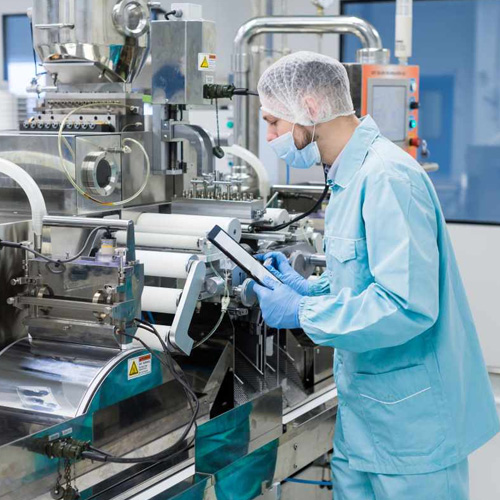
What is a vial powder filling and rubber stoppering machine?
It is an integrated aseptic system that doses a precise weight of sterile powder into a sterile glass vial and seats a sterile rubber stopper on top — all under ISO 5 / Grade A unidirectional airflow. It is the workhorse of any sterile powder injectable line (antibiotic, lyophilized, vaccine, biologic).
What is the difference between auger, vacuum, and dosing-disc powder fillers?
Auger: best for free-flowing powders (50 mg – 50 g) with ±0.5% accuracy. Vacuum: best for lyophilized cakes, low-bulk-density, and cohesive powders (5 mg – 5 g) with ±1% accuracy. Dosing disc: best for very small doses (1 mg – 500 mg) of vaccine or biologic at ±0.25% accuracy.
What is the difference between powder filling and liquid filling?
Powder filling uses auger, vacuum, or dosing-disc principles and is highly sensitive to powder flow properties (angle of repose, bulk density, particle size, cohesion). It requires dust control, nitrogen blanketing, and a carefully balanced aseptic-zone airflow to keep particles out of the Grade A environment.
What fill weight accuracy can a vial powder filler achieve?
Auger: ±0.5% (free-flowing) to ±1% (cohesive). Vacuum: ±1%. Dosing disc: ±0.25%. All are validated per USP <905> with gravimetric verification and 100% in-process check-weighing.
How is sterile powder handled in the aseptic zone?
Sterile powder is delivered in a closed, gamma-irradiated container and transferred under ISO 5 / Grade A airflow through a sterilizable split-butterfly valve or Rapid Transfer Port (RTP) into the filler’s dosing hopper, blanketed with sterile-filtered nitrogen.
How does the integrated rubber stoppering work on a powder filler?
A vibratory bowl feeder orients sterile rubber stoppers. A gripper picks one stopper per cycle, places it on the vial mouth, and a servo-driven pre-press head seats it to a recipe-defined depth. Pre-stoppered vials exit for capping; for lyophilized products, pre-stoppered vials enter a freeze dryer for final stoppering under vacuum.
What air cleanliness is required at the powder filling point?
ISO 5 / Grade A unidirectional airflow per EU GMP Annex 1 (2022) and USFDA aseptic-processing guidance. Powder filling is more challenging than liquid filling because powder particles become airborne during dosing — so the laminar flow must be carefully balanced.
How is a vial powder filler validated?
Validation follows a 3-stage approach: IQ/OQ on the installed machine, placebo media fill with growth medium per Annex 1 (contaminated vials < 0.1%), and performance qualification with three production-scale batches. Powder path is swab-tested for microbial recovery.
What utilities does a vial powder filling machine require?
415V AC 3-phase power, 8-15 kW connected load; 5-7 bar oil-free compressed air; clean steam for SIP; WFI for CIP; HEPA-filtered air for laminar flow; sterile-filtered nitrogen (99.99% purity) for powder blanketing; vacuum for powder transfer and stopper placement.
What is the difference between powder filling and lyophilization?
Powder filling doses a pre-made sterile powder. Lyophilization takes a liquid solution in a vial, freezes it, and removes water under vacuum to produce a powder cake inside the vial. A powder filler is used when the powder is supplied as a sterile bulk; a lyophilizer is used when the product is supplied as a liquid and must be dried in the vial.
Do you export vial powder filling and rubber stoppering machines outside India?
Yes. As a vial powder filling and rubber stoppering machine exporter based in Ahmedabad, Gujarat, we ship to 25+ countries including USA, UK, Germany, Brazil, Mexico, UAE, Saudi Arabia, Bangladesh, Sri Lanka, Nepal, Afghanistan, Egypt, Kenya, Nigeria, South Africa, Vietnam, Philippines, and Indonesia.
What after-sales support do you offer?
We provide 1-year comprehensive warranty, lifetime remote support via video call / TeamViewer / WhatsApp Business, on-site service across India and abroad, AMC options with preventive maintenance and recalibration, and spare parts kits shipped within 24-48 hours globally from regional warehouses. Standard delivery: 12-16 weeks for standard machines, 16-22 weeks for custom configurations. Installation and validation typically add 4-6 weeks on site.