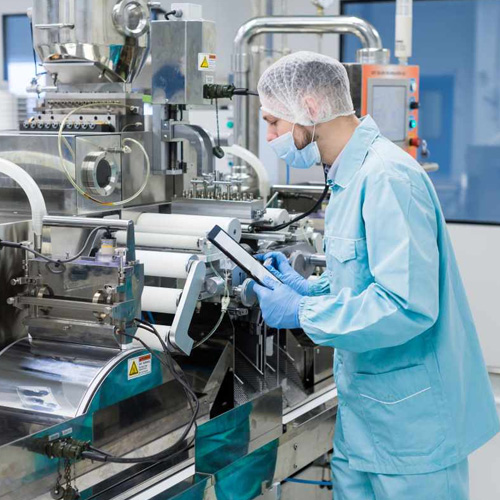
- Product Overview
- Wrap-Around Vial Labeling Machine
- Front-and-Back Vial Labeling Machine
- High-Speed Rotary Vial Labeling Machine with Serialization
- Wrap-Around vs Front-and-Back vs High-Speed Rotary
- Pharmaceutical Serialization: DSCSA, FMD, and Beyond
- Technical Specifications
- Labeling Validation: A 5-Step How-To
- USP, EP, Annex 1, and Track-and-Trace Compliance
- Inline Integration with Inspection and Packaging
- Frequently Asked Questions
- Installation, Validation, and Support
- Request a Quote

Product Overview
A vial labeling machine applies self-adhesive paper or film labels to parenteral glass vials, typically carrying the product name, strength, lot number, expiry date, manufacturer, and (under modern serialization regulations) a unique 2D Data Matrix code. It is the second-to-last step on the parenteral line, after the inspection booth and before secondary packaging. Three configurations dominate pharmaceutical production:
- Wrap-Around Type — single self-adhesive label wrapped around the vial body, the standard for parenteral vials. Up to 200 VPM. Used in commercial parenteral manufacturing.
- Front-and-Back Type — two separate labels applied to the front and back of the vial, used when product and regulatory information must be split. Up to 150 VPM. Used in clinical and niche production.
- High-Speed Rotary Type — multi-head rotary for very high-volume production (200–600 VPM) with integrated 2D Data Matrix serialization, batch coding, and 100% vision verification. Used for DSCSA and FMD compliance.
All three configurations are built from SS 316L stainless steel with HEPA-filtered ISO 7 / Grade C background, recipe-driven changeover, 21 CFR Part 11-ready control, and full IQ/OQ documentation for WHO-GMP, EU GMP Annex 1, DSCSA, FMD, and USFDA injectable facilities.
Wrap-Around Vial Labeling Machine
What it is and when to use it
The Wrap-Around Vial Labeling Machine applies a single self-adhesive label that wraps around the vial body, with the label ends overlapping on the back. The label dispense head peels the label from the backing paper, accelerates it to the vial speed, and wraps it around the vial at a wrap-belt station. A vision system verifies label position, batch coding, and (if serialized) the 2D Data Matrix code. Output: up to 200 vials/min.
Use this machine when: you run a commercial parenteral or vaccine line at standard speed; you need a single self-adhesive label per vial; and you need batch coding and (optionally) serialization.
Key Engineering Features
- Wrap-around label dispense head: SS 316L dispense head with quick-change label rolls; recipe-driven dispense position and wrap-belt speed.
- Self-adhesive label handling: label roll diameter up to 400 mm, label width 30–100 mm, label length 30–150 mm; backing paper automatically rewound for disposal.
- Integrated batch coding: thermal-inkjet or laser coder prints lot number, expiry date, and manufacturing date on the label before application; recipe-driven data input from the line PLC.
- Optional 2D Data Matrix serialization: thermal-transfer or laser marking of unique serial numbers per vial, encoded in a 2D Data Matrix code per ISO/IEC 15415.
- Vision verification system: 1–2 cameras per station verify label position (height, centring, rotation within ± 0.5 mm and ± 1°), batch coding readability, and barcode grade per ISO/IEC 15416 (grade C or better).
- Automatic reject station: out-of-spec vials (missing label, misaligned label, unreadable code) are diverted to a reject bin at the discharge end.
- SS 316L contact parts: all vial-contact surfaces in AISI 316L; SS 304 frame.
- PLC + HMI control: Siemens / Allen-Bradley PLC, 7–10″ color touchscreen, recipe storage, real-time SPC trending, alarm history, 21 CFR Part 11 audit trail, EPCIS upload for serialized lines.
- Safety and access: CE marked per EN 60204-1, interlocked guard, emergency stop.
Specifications — Wrap-Around
| Parameter | Specification |
|---|---|
| Throughput | 60–200 vials/minute, depending on vial format and label size |
| Vial Size Range | 2 ml–100 ml tubular glass vials conforming to ISO 8362-1 |
| Vial Diameter | 14 mm–52 mm |
| Vial Height | 30 mm–115 mm |
| Label Type | Self-adhesive paper or film wrap-around labels |
| Label Width | 30–100 mm |
| Label Length | 30–150 mm |
| Label Roll Diameter | Up to 400 mm |
| Label Position Accuracy | ±0.5 mm height, ±0.5 mm centring and ±1° rotation |
| Batch Coding | Thermal-inkjet or laser coding for lot number, expiry date and manufacturing date |
| Serialization (Optional) | Thermal-transfer or laser printing of 2D Data Matrix codes in accordance with ISO/IEC 15415 |
| Vision Verification | 1–2 cameras per station with barcode verification grade ≥ C in accordance with ISO/IEC 15416 |
| Reject Station | Automatic pneumatic diverter for transferring rejected vials into a separate reject bin |
| Contact Parts | SS316L stainless steel with a surface finish of Ra ≤ 0.8 µm |
| Non-Contact Frame | SS304 stainless-steel frame with an epoxy-coated mild-steel base |
| Power Supply | 230 V / 415 V AC, single-phase or 3-phase, 50–60 Hz |
| Power Consumption | 1.5–3.0 kW |
| Compressed Air | 5–7 bar oil-free compressed air, 50–150 litres/minute |
| Noise Level | ≤ 72 dB(A) |
| Machine Footprint | 2,000–2,800 mm L × 900–1,200 mm W × 1,600–1,900 mm H |
| Machine Weight | 600–1,200 kg |
| Warranty | 12 months comprehensive warranty with lifetime technical support |
Front-and-Back Vial Labeling Machine
What it is and when to use it
The Front-and-Back Vial Labeling Machine applies two separate self-adhesive labels to the front and back of the vial in a single pass. The two label dispense heads are mounted in series; the front label is applied first, then the vial is rotated 180° and the back label is applied. This configuration is used when product information (front) and regulatory information (back) must be split, or when the wrap-around label would be too long to fit on small vials. Output: up to 150 vials/min.
Use this machine when: you need to split product and regulatory information across two labels; your vial format requires smaller labels than a wrap-around would allow; or you need front-and-back labeling for cultural or regulatory reasons (e.g., bilingual labels).
Key Engineering Features
- Twin label dispense heads: two SS 316L dispense heads in series, each with quick-change label rolls; front label applied first, back label applied after a 180° vial rotation.
- Self-adhesive label handling: two label rolls (front and back), each with its own dispenser and rewind; supports different label sizes for front and back.
- Integrated batch coding: thermal-inkjet or laser coder prints lot, expiry, and date on the front label before application; optional 2D Data Matrix serialization.
- Vision verification system: 1–2 cameras verify both front and back label position, batch coding, and serialization; out-of-spec vials are automatically rejected.
- SS 316L contact parts: all vial-contact surfaces in AISI 316L; SS 304 frame.
- PLC + HMI control: recipe storage for front / back label size and content, batch coding, and serialization; 21 CFR Part 11 audit trail.
Specifications — Front-and-Back
| Parameter | Specification |
|---|---|
| Throughput | 40–150 vials/minute, depending on vial format and label size |
| Vial Size Range | 2 ml–100 ml tubular glass vials conforming to ISO 8362-1 |
| Vial Diameter | 14 mm–52 mm |
| Vial Height | 30 mm–115 mm |
| Label Type | Self-adhesive paper or film labels for front-and-back application |
| Label Width (Each) | 30–80 mm |
| Label Length (Each) | 30–80 mm |
| Label Roll Diameter | Up to 400 mm for each labelling head |
| Label Position Accuracy | ±0.5 mm height, ±0.5 mm centring and ±1° rotation |
| Batch Coding | Thermal-inkjet or laser coding for lot number, expiry date and manufacturing date |
| Serialization (Optional) | Thermal-transfer or laser printing of 2D Data Matrix codes in accordance with ISO/IEC 15415 |
| Vision Verification | 1–2 cameras per station with barcode verification grade ≥ C in accordance with ISO/IEC 15416 |
| Reject Station | Automatic pneumatic diverter for transferring rejected vials into a separate reject bin |
| Contact Parts | SS316L stainless steel with a surface finish of Ra ≤ 0.8 µm |
| Non-Contact Frame | SS304 stainless-steel frame with an epoxy-coated mild-steel base |
| Power Supply | 230 V / 415 V AC, single-phase or 3-phase, 50–60 Hz |
| Power Consumption | 1.5–3.5 kW |
| Compressed Air | 5–7 bar oil-free compressed air, 50–200 litres/minute |
| Noise Level | ≤ 72 dB(A) |
| Machine Footprint | 2,400–3,200 mm L × 900–1,200 mm W × 1,600–1,900 mm H |
| Machine Weight | 800–1,500 kg |
| Warranty | 12 months comprehensive warranty with lifetime technical support |
High-Speed Rotary Vial Labeling Machine with Serialization
What it is and when to use it
The High-Speed Rotary Vial Labeling Machine with Serialization is a multi-head rotary machine designed for very high-volume production (200–600 VPM) with integrated 2D Data Matrix serialization, batch coding, and 100% vision verification. Vials are conveyed on a continuously rotating star-wheel through a print-and-apply station (where each label is printed with a unique serial number on demand), a label dispense head, a wrap-belt station, and a multi-camera vision system. Output: up to 600 vials/min with full DSCSA / FMD compliance.
Use this machine when: you run very high-volume commercial production (millions of vials per year); you must comply with DSCSA, FMD, or other serialization regulations; you need 100% vision verification with documented reject rate; and you can justify the higher capital cost.
Key Engineering Features
- Multi-head rotary index plate: 4–8 label dispense heads on a continuously rotating star-wheel, each with its own print-and-apply station for serialized codes.
- On-demand thermal-transfer printing: each head prints a unique 2D Data Matrix code on the label as the vial passes; print speed matched to the rotary index.
- Optional laser marking: for permanent serialization on glass or cap (in addition to or instead of label printing), for products that must survive sterilization or harsh environments.
- 100% vision verification: 4–8 high-resolution cameras verify label position, batch coding, and 2D Data Matrix code readability; out-of-spec vials are automatically rejected.
- EPCIS / track-and-trace integration: the machine uploads each serial number to the manufacturer’s EPCIS / track-and-trace database in real time, with full audit trail.
- DSCSA / FMD compliance: the system supports GTIN, lot, expiry, serial number, and (for FMD) the unique identifier per the EU Falsified Medicines Directive.
- High-speed reject station: servo-driven diverter, 600 VPM, with fail-safe design (power loss = reject).
- SS 316L contact parts: all vial-contact surfaces in AISI 316L with Ra ≤ 0.8 µm.
- Industrial PC + PLC control: 15″ color touchscreen, real-time SPC trending, alarm history, 21 CFR Part 11 audit trail, and database interface.
Specifications — High-Speed Rotary with Serialization
| Parameter | Specification |
|---|---|
| Throughput | 200–600 vials/minute, depending on vial format and label size |
| Vial Size Range | 2 ml–100 ml tubular glass vials conforming to ISO 8362-1 |
| Vial Diameter | 14 mm–52 mm |
| Vial Height | 30 mm–115 mm |
| Label Type | Self-adhesive paper or film wrap-around labels |
| Label Width | 30–100 mm |
| Label Length | 30–150 mm |
| Label Heads | 4–8 labelling heads with rotary-index operation |
| Batch Coding | Thermal-transfer on-demand printing for lot number, expiry date and manufacturing date |
| Serialization | 2D Data Matrix coding in accordance with ISO/IEC 15415, including GTIN, lot number and unique serial number |
| Laser Marking (Optional) | Fibre or CO₂ laser for permanent coding directly on the vial glass or cap |
| Vision Verification | 4–8 cameras with barcode verification grade ≥ C in accordance with ISO/IEC 15416 |
| Track-and-Trace | EPCIS 1.2 data upload supporting GTIN, GLN, lot number, serial number and expiry date |
| Compliance | Supports DSCSA requirements for the United States, FMD for the European Union, India DGFT, China NMPA, Brazil ANVISA and Saudi SFDA requirements |
| Reject Station | Fail-safe servo-driven diverter capable of handling up to 600 vials/minute |
| Contact Parts | SS316L stainless steel with a surface finish of Ra ≤ 0.8 µm |
| Non-Contact Frame | SS304 stainless-steel frame with an epoxy-coated mild-steel base |
| Power Supply | 415 V AC, 3-phase, 50–60 Hz |
| Power Consumption | 4.0–8.0 kW |
| Compressed Air | 5–7 bar oil-free compressed air, 100–300 litres/minute |
| Noise Level | ≤ 76 dB(A) |
| Machine Footprint | 3,500–5,500 mm L × 1,500–2,000 mm W × 1,800–2,200 mm H |
| Machine Weight | 2,500–5,000 kg |
| Warranty | 12 months comprehensive warranty with lifetime technical support |
Wrap-Around vs Front-and-Back vs High-Speed Rotary: Which Labeler Do You Need?
The choice between wrap-around, front-and-back and high-speed rotary vial labelling machines depends on label content, required throughput and pharmaceutical serialization requirements.
| Parameter | Wrap-Around | Front-and-Back | High-Speed Rotary |
|---|---|---|---|
| Mode | In-line operation with start-stop or continuous vial movement | In-line operation using twin labelling heads installed in series | Multi-head rotary labelling operation |
| Throughput | 60–200 vials/minute | 40–150 vials/minute | 200–600 vials/minute |
| Labels per Vial | 1 wrap-around label | 2 separate labels for front-and-back application | 1 wrap-around label with on-demand printing |
| Batch Coding | Yes, using thermal-inkjet or laser coding | Yes, using thermal-inkjet or laser coding | Yes, using thermal-transfer on-demand printing |
| Serialization | Optional serialization module | Optional serialization module | Standard built-in serialization system |
| Track-and-Trace Integration | Optional integration | Optional integration | Standard EPCIS data-upload integration |
| DSCSA / FMD Compliance | Supported with an optional serialization module | Supported with an optional serialization module | Built-in support for serialization compliance workflows |
| Capital Cost (USD) | $25K–$70K | $35K–$90K | $100K–$300K |
| Best For | Commercial parenteral production lines requiring one continuous label | Products requiring separate front-and-back labels, including bilingual packaging | High-volume commercial production with integrated serialization |
| Footprint | Approximately 2–2.8 metres of production-line length | Approximately 2.4–3.2 metres of production-line length | Approximately 3.5–5.5 metres of production-line length |
| Validation Burden | Moderate: label-position accuracy and batch-code verification | Moderate: front-and-back label positioning and batch-code verification | High: label positioning, batch coding, 2D-code verification and EPCIS integration |
| Operator Skill | Low, with recipe-driven PLC and HMI operation | Low, with recipe-driven PLC and HMI operation | Moderate, requiring recipe management and EPCIS database-interface knowledge |
| Common Downstream | Cartoning, leaflet insertion and case packing | Cartoning, leaflet insertion and case packing | Cartoning, leaflet insertion and case packing |
For most commercial parenteral production lines, a wrap-around labeller is the standard choice. For products requiring separate front-and-back labels, such as bilingual packaging, a front-and-back labeller is required. For very high-volume production with integrated serialization and track-and-trace compliance, a high-speed rotary labeller provides the required throughput and data-management capability.
Pharmaceutical Serialization: DSCSA, FMD, and Beyond
Pharmaceutical serialization is the assignment of a unique serial number to each saleable unit of a prescription drug, encoded in a 2D Data Matrix barcode and tracked in a centralized database. It is mandatory in many countries:
- US — DSCSA (Drug Supply Chain Security Act): effective since 2018 for manufacturers, with full track-and-trace by 2023. Each saleable unit (vial, bottle, carton) must carry a 2D Data Matrix with GTIN, lot, expiry, and serial number. Data is exchanged via EPCIS 1.2 between trading partners.
- EU — Falsified Medicines Directive (FMD): effective since February 2019. Each saleable unit must carry a 2D Data Matrix with GTIN (NTIN/PPN), lot, expiry, and serial number. Data is uploaded to the European Medicines Verification System (EMVS) via the manufacturer’s national system.
- India — DGFT / DAVA: export-oriented drugs require 2D Data Matrix with GTIN, batch, expiry, and serial. Domestic market serialization is being rolled out in phases from 2023.
- China — NMPA: full serialization since 2021, with GTIN, batch, expiry, serial, and a regulatory code. Data uploaded to the NMPA platform.
- Brazil — ANVISA: serialization since 2022 with GTIN, batch, expiry, serial, and ANVISA-specific code.
- Saudi Arabia — SFDA: serialization required for imported drugs since 2018 and for locally manufactured drugs since 2019.
A modern high-speed rotary vial labeler with integrated serialization handles all of these requirements: on-demand printing of the 2D Data Matrix, vision verification, EPCIS / track-and-trace database upload, and full 21 CFR Part 11 audit trail. The capital cost is higher than a non-serialized labeler, but the operational benefits (regulatory compliance, anti-counterfeiting, recall traceability) are substantial.
Labeling Validation: A 5-Step How-To
Labeling validation is governed by 21 CFR 211.1301, DSCSA, FMD, and the relevant track-and-trace regulations. The following sequence is a practical, audit-tested approach used by our customers’ QA teams.
Document the vial formats, the label sizes, the batch-coding fields (lot, expiry, manufacturing date), the serialization requirements (2D Data Matrix, GTIN, serial number), the target throughput, and the air cleanliness (ISO 7 / Grade C). Lock these in a User Requirements Specification (URS) before ordering.
Run the IQ checklist (utilities, instrumentation, materials of construction, calibration) followed by OQ tests (no-vial dry cycle, alarm verification, sensor calibration, interlock function, label dispense head function, vision system function, print-and-apply function for serialized codes). Document deviations and resolutions.
Label 100 consecutive vials and inspect for label position (height, centring, rotation within ± 0.5 mm and ± 1°), adhesion (peel strength per ASTM D3330, no lifting after 24-hour dwell), barcode readability (per ISO/IEC 15415 / 15416 for 2D codes, grade C or better), and absence of wrinkles or skew.
For serialized lines: verify each serial number against the track-and-trace database, confirm no duplicate serial numbers within the batch, document the vision system rejection rate (typically < 0.1%), and confirm the upload to the manufacturer’s EPCIS / track-and-trace system is successful for every vial.
Execute three consecutive production-scale batches. Verify label application quality per batch, batch-coding accuracy, serialization compliance (if applicable), and 21 CFR Part 11 audit trail completeness. Issue the final validation report signed by QA, engineering, and production.
Estimated timeline: 3–4 weeks from IQ start to final report, depending on database interface readiness.
Estimated cost: $8,000 – $15,000 in QA and IT fees for a single vial format.
USP, EP, Annex 1, and Track-and-Trace Compliance
Every machine is engineered and documented against the following standards:
- 21 CFR 211.1301 — Labeling (US)
- 21 CFR Part 11 — Electronic Records and Signatures
- USP <1> — Injections (general)
- USP <659> — Packaging and Storage Requirements
- USP <1079> — Good Storage and Distribution Practices
- EU GMP Annex 1 (2022) — Manufacture of Sterile Medicinal Products
- DSCSA (US) — Drug Supply Chain Security Act
- FMD (EU) — Falsified Medicines Directive (2011/62/EU) and Delegated Regulation 2016/161
- ISO/IEC 15415 — 2D Barcode Print Quality
- ISO/IEC 15416 — Linear Barcode Print Quality
- ISO/IEC 16022 — Data Matrix Symbology
- GS1 GTIN, GLN, SSCC — Global Trade Item Number standards
- EPCIS 1.2 — EPC Information Services standard
- WHO TRS 986 Annex 2 — WHO GMP for Pharmaceutical Products
- ISO 9001:2015 — Quality Management
- CE Machinery Directive 2006/42/EC
Inline Integration with Inspection and Packaging
A vial labeling machine is the second-to-last step on a parenteral injectable line:
- Upstream: Vial unscrambler → rotary gripper washer → depyrogenation tunnel → cooling conveyor → automatic vial filling and rubber stoppering machine → vial cap sealing machine → vial inspection conveyor booth
- Labeler: Vial labeling machine (wrap-around / front-and-back / high-speed rotary with serialization)
- Downstream: Secondary packaging (cartoning, leaflet insertion, case packing) → palletizing
Our labelers are designed for direct feed from our inspection booths, with matched conveyor speed, pitch, and entry/exit height. The exit feeds the cartoner with no operator handling between label and carton.
Frequently Asked Questions
It applies self-adhesive paper or film labels to parenteral glass vials — carrying product name, strength, lot, expiry, manufacturer, and (under modern serialization) a unique 2D Data Matrix code. It is the second-to-last step on the parenteral line, before secondary packaging.
Wrap-around: single label wrapped around the vial body, the standard for parenterals (60–200 VPM). Front-and-back: two separate labels applied to front and back of the vial, used for split or bilingual labels (40–150 VPM). High-speed rotary: multi-head rotary for very high-volume production with integrated 2D Data Matrix serialization (200–600 VPM).
Serialization is the assignment of a unique serial number to each saleable unit, encoded in a 2D Data Matrix barcode and tracked in a centralized database. It is mandatory under DSCSA (US, since 2018), FMD (EU, since 2019), and similar regulations in India, China, Brazil, Saudi Arabia, and other countries.
ISO 7 / Grade C background per EU GMP Annex 1 (2022) and USFDA aseptic-processing guidance — not ISO 5 / Grade A. The vial is already closed, capped, and inspected by the time it reaches the labeler.
Validation covers: IQ/OQ on the installed machine; label application qualification (position, adhesion, barcode readability per ISO/IEC 15415 / 15416); serialization qualification (unique serial numbers, EPCIS upload); and PQ with three production batches.
Standard labelers handle 2 ml – 100 ml tubular glass vials (14–52 mm diameter, 30–115 mm height). Label dimensions: 30 × 30 mm to 100 × 150 mm for wrap-around; 30 × 30 mm to 80 × 80 mm for front-and-back. Format changeover is recipe-driven in 5–15 minutes.
230V / 415V AC power, 1–5 kW connected load; 5–7 bar oil-free compressed air; LAN / Ethernet for track-and-trace database connection, 21 CFR Part 11 audit trail, and remote support. No clean steam, WFI, or nitrogen required.
Batch coding prints lot, expiry, and date — same value for every vial in a batch. Serialization prints a unique serial number on each individual vial, encoded in a 2D Data Matrix. Both are required under modern regulations, and modern labelers handle both.
Pressure-sensitive (self-adhesive): pre-printed labels with backing paper, peeled and pressed onto the vial. Standard in pharma. Glue-applied: hot-melt or cold-glue adhesive applied at the dispense station. Rare in pharma because of the cleaning burden and slower speeds.
Standard configurations cover 60–600 vials/min. Wrap-around: 60–200 VPM. Front-and-back: 40–150 VPM. High-speed rotary: 200–600 VPM with multi-head rotary indexing and integrated serialization.
Customer Outcomes
“We replaced a hand-applied label station with the wrap-around vial labeler on our vaccine line. Throughput jumped from 90 VPM manual to 180 VPM automatic, label position CV dropped from ± 2 mm to ± 0.3 mm, and we cleared the WHO prequalification audit on the first attempt with zero observations on the labeling step.”
— Plant Director, Vaccine Manufacturer, Pune (reference available on request)
“The high-speed rotary labeler with DSCSA serialization on our generics line runs 480 VPM with 0.06% vision reject rate. EPCIS upload to our track-and-trace platform is real-time, and our serialization rejection log is fully 21 CFR Part 11 compliant. The FDA inspector said it was the cleanest serialization implementation she had seen in 2024.”
— Engineering Lead, Generics Injectables CDMO, Ahmedabad (reference available under NDA)
“Front-and-back labeler on our bilingual product line lets us carry English on the front and Arabic on the back, in compliance with the Saudi SFDA. Format changeover between 10 ml and 50 ml SKUs is 8 minutes with no tools.”
— Production Head, Generics Injectables Manufacturer, Cairo, Egypt (reference available on request)
Installation, Validation, and Support
Every machine is delivered as a turnkey project with the following scope:
- Pre-shipment Factory Acceptance Test (FAT) at our facility, with label application qualification, vision verification, and serialization test runs (if applicable)
- On-site installation, commissioning, and Site Acceptance Test (SAT)
- IQ and OQ execution support, including protocol walkthrough with your QA team
- Operator and maintenance training (typically 3 days)
- 1-year comprehensive warranty covering parts and labor
- Lifetime remote support via video call, TeamViewer, and WhatsApp business
- Annual Maintenance Contract (AMC) options including preventive maintenance, vision system recalibration, and print-head replacement
- Spare parts kits shipped within 24–48 hours globally from regional warehouses
Typical delivery times: Standard machines ship in 8–12 weeks; high-speed rotary systems with serialization in 14–20 weeks. Installation and validation typically add 2–4 weeks on site.
Industries We Serve
- Pharmaceutical and biopharmaceutical manufacturing
- Vaccine and biological manufacturing
- Lyophilized (freeze-dried) injectables
- Sterile ophthalmic and nasal sprays
- Veterinary injectables
- Contract development and manufacturing organizations (CDMOs)
Certifications and Compliance
- ISO 9001:2015 Certified Manufacturing
- CE Marking (Machinery Directive 2006/42/EC)
- cGMP-Compliant Design
- WHO-GMP Compatible
- USFDA-Ready Configurations
- EU GMP Annex 1 (2022) Compatible
- DSCSA and FMD Compliant (with serialization module)
Related Vial Processing Equipment
- Vial Washing Machine
- Vial Depyrogenation Tunnel
- Automatic Vial Filling and Rubber Stoppering Machine
- Vial Powder Filling and Rubber Stoppering Machine
- Vial Cap Sealing Machine
- Vial Inspection Conveyor Booth
Request a Free Quote
Get a customized quotation with full technical specifications, utility consumption estimate, validation plan, and line-layout proposal within 24 hours.
- Request a Quote (/quote/vial-washing-machine)
- +91 96012 74176
- Email Sales (mailto:info@pharmamachineryind.com)
All Rights Reserved. Manufacturer of pharmaceutical vial processing machinery with 30+ years of experience, exporting to 25+ countries including India, the United States, the United Kingdom, Germany, Brazil, Mexico, Kenya, Nigeria, South Africa, the UAE, Saudi Arabia, Egypt, Thailand, Vietnam, the Philippines, and Indonesia.