Should you buy an automatic filling machine or a semi-automatic filling machine? It is the most common question we get from pharma factory owners, and the honest answer is: it depends on your volume, your budget, and your growth plans. In 2026, India alone has more than 12,000 pharma manufacturing units, and roughly 60% of them still run semi-automatic lines. That is not because automatic machines are bad — it is because the right machine depends on the stage your business is in.
This guide gives you a fair, side-by-side comparison of both. We will look at speed, accuracy, cost, labour, GMP, ROI, and a simple decision flowchart that tells you in 60 seconds which type fits your factory. We will also share the 3 most common mistakes people make when choosing between automatic and semi-automatic — and how to avoid them. By the end, you will know exactly which filling machine your business needs today, and how to plan the upgrade for tomorrow.
Table of Contents
- What Is an Automatic Filling Machine?
- What Is a Semi-Automatic Filling Machine?
- Head-to-Head Comparison: 12 Factors
- Speed, Cost, and Accuracy Tables
- GMP and Regulatory Compliance
- ROI: When Does Automatic Pay for Itself?
- Decision Flowchart: Which One Should You Buy?
- 3 Common Mistakes to Avoid
- How to Upgrade from Semi to Automatic
- Frequently Asked Questions
What Is an Automatic Filling Machine?
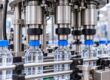
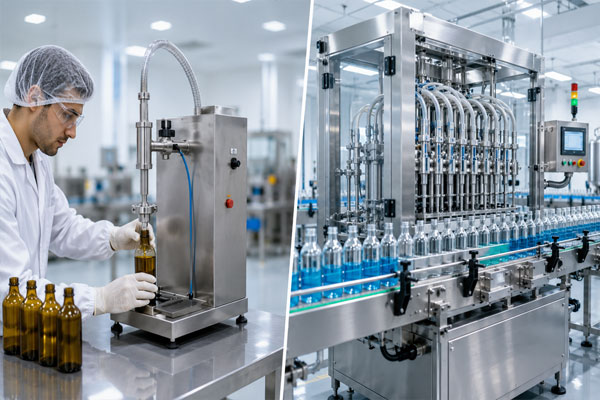
An automatic filling machine is a system that performs the entire filling process on its own, with little or no human help. Bottles are fed in by a conveyor or unscrambler, the machine fills them, caps them, and often labels them — all in one continuous motion. The operator only needs to set the parameters on the HMI touchscreen, monitor the line, and top up the bulk tank.
Main parts of an automatic line
- Turntable or unscrambler: Feeds empty bottles in the right orientation.
- Rinser (optional): Washes bottles with air, water, or ionized air.
- Filler: The metering system (piston, peristaltic, gear pump) that measures and dispenses the liquid.
- Capper: Picks up and tightens the cap (screw, ROPP, crimp, press-on).
- Labeller (optional): Applies front, back, and batch labels.
- Conveyor and control panel: Links everything and runs the recipe.
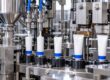
When the rinser, filler, and capper are combined into one machine, it is called a monobloc. Monobloc fillers save floor space, reduce bottle handling, and improve GMP compliance.
What Is a Semi-Automatic Filling Machine?
A semi-automatic filling machine fills bottles automatically, but a human operator must place each empty bottle under the nozzle and remove each filled bottle by hand. The machine handles the metering and dispensing, the human handles the loading. Capping, if any, is usually done on a separate benchtop capper.
Who buys semi-automatic machines?
- Startups in their first 1 to 3 years of operation.
- Small-batch manufacturers (under 5,000 bottles per day).
- R&D and pilot plant labs.
- Companies making 5 to 10 different SKUs that change every day.
- Contract manufacturers doing small trial batches.
Key Takeaway:
“Semi-automatic” does not mean low quality. Many GMP-certified pharmaceutical companies in India, Southeast Asia, and Africa still use semi-automatic fillers for their validation batches and small SKUs. The key is matching the machine to the volume.
Head-to-Head Comparison: 12 Factors
Here is a deep, side-by-side comparison of automatic vs semi-automatic filling machines across 12 factors that matter to pharma buyers.
| Factor | Semi-Automatic | Automatic |
|---|---|---|
| Speed (BPM) | 10–30 bottles per minute | 30–400 bottles per minute |
| Operators Needed | 2 to 4 per shift | 1 to 2 per shift |
| Fill Accuracy | ±1% to ±2% | ±0.3% to ±0.5% |
| Investment (India 2026) | ₹1.5 lakh – ₹8 lakh | ₹15 lakh – ₹4 crore |
| Floor Space | 2 m × 2 m | 4 m × 8 m and up |
| Power & Air Needed | Single phase, no air | 3-phase, 6 bar compressed air |
| Cleaning Time | 15–30 minutes | 30–90 minutes (CIP possible) |
| GMP Compliance | Manual discipline needed | Built-in data logging and recipe control |
| Validation | Simple IQ/OQ | Full DQ/IQ/OQ/PQ |
| Changeover Time | 5–10 minutes | 10–30 minutes |
| Batch Record | Paper or manual | Electronic, with audit trail |
| Best For | Startups, small batches and R&D | Large factories, exports and contract manufacturing |
Speed, Cost, and Accuracy Tables
Speed comparison (bottles per minute)
| Daily Target | Semi-Automatic (BPM) | Automatic (BPM) |
|---|---|---|
| 1,000 bottles/day | 5–10 BPM (1 operator) | Overkill |
| 5,000 bottles/day | 15–25 BPM (2 operators) | 30–60 BPM (1 operator) |
| 20,000 bottles/day | Not practical | 60–120 BPM (1 operator) |
| 50,000 bottles/day | Not possible | 150–300 BPM (2 operators) |
| 100,000+ bottles/day | Not possible | 300–400 BPM (2 operators) |
Cost comparison (India 2026, INR)
| Component | Semi-Automatic | Automatic (Monobloc) |
|---|---|---|
| Machine Cost | ₹1.5 – ₹8 lakh | ₹15 lakh – ₹1.5 crore |
| Installation | ₹10,000 – ₹30,000 | ₹1 – ₹5 lakh |
| Validation | ₹50,000 – ₹1 lakh | ₹2 – ₹8 lakh |
| Training | Included | ₹30,000 – ₹1 lakh |
| Annual Maintenance | ₹15,000 – ₹50,000 | ₹1 – ₹6 lakh |
| Operators per Shift | 2–4 (₹12,000/month each) | 1–2 (₹15,000/month each) |
Accuracy comparison
| Technology | Semi-Auto Accuracy | Automatic Accuracy |
|---|---|---|
| Piston | ±1.0% | ±0.5% |
| Servo Piston | ±0.7% | ±0.3% |
| Peristaltic | ±1.5% | ±0.8% |
| Gear Pump | ±1.5% | ±1.0% |
| Gravity | ±3–5% | ±2% |
GMP and Regulatory Compliance
Both machine types can be GMP-compliant. The difference is how much effort it takes.
Semi-automatic + GMP
- You need more SOPs and operator training.
- Manual batch records (paper) must be filled and checked.
- Cleaning must be logged step by step.
- More human variation = more audit risk.
Automatic + GMP
- Recipe memory ensures every batch is identical.
- Electronic batch records with timestamps.
- CIP reduces manual cleaning errors.
- Data logged for FDA 21 CFR Part 11.
- Lower audit risk, faster validation.
Real audit case:
A mid-size pharma unit in Maharashtra used 3 semi-automatic stations. During a US FDA audit, the inspector flagged 14 observations — most about manual data gaps. After upgrading to a single monobloc line with electronic records, the next audit had 0 observations. The ₹80 lakh upgrade saved the company from a possible import ban.
ROI: When Does Automatic Pay for Itself?
Let’s do the math for a typical Indian pharma company filling cough syrup at ₹80 profit per 100 ml bottle.
Semi-automatic setup:
– 3 stations, 4 operators per shift
– 6,000 bottles/day
– Labour cost per year: 4 × 2 shifts × ₹15,000 × 12 = ₹14.4 lakh/year
– Product waste (1.5% overfill): 6,000 × 0.015 × ₹8 = ₹720/day = ₹2.6 lakh/year
– Total annual cost: ~₹17 lakh
Automatic monobloc:
– 1 line, 1 operator per shift
– 8,000 bottles/day (higher speed)
– Labour cost per year: 1 × 2 × ₹18,000 × 12 = ₹4.3 lakh/year
– Product waste (0.4% overfill): 8,000 × 0.004 × ₹8 = ₹256/day = ₹0.9 lakh/year
– Total annual cost: ~₹5.2 lakh
Annual saving: ₹11.8 lakh
Automatic line cost: ₹60 lakh
Payback: 60 / 11.8 = 5 years
The payback improves if your profit per bottle is higher (export, niche drug, biopharma) or if your daily volume is higher. For most Indian pharma companies filling 20,000+ bottles per day, the automatic line pays back in 2 to 3 years.
Rule of thumb:
If your annual labour + waste cost is more than 30% of the automatic line price, you will pay back in under 4 years. If it is less than 15%, stick with semi-automatic.
Decision Flowchart: Which One Should You Buy?
Answer these 5 questions in order. The flowchart leads you to the right answer.
- How many bottles do you fill per day?
– Under 3,000 → Semi-automatic
– 3,000 to 20,000 → Either, depending on next 2 questions
– Over 20,000 → Automatic
- How many different products or SKUs do you run?
– 1 to 3 → Automatic is fine
– 5 to 20 → Automatic with recipe memory
– Over 20 or frequent changeovers → Semi-automatic (easier to swap)
- Do you sell to regulated export markets (US, EU, UK)?
– Yes → Automatic (electronic records are almost required)
– No → Either works
- How much floor space and compressed air do you have?
– Less than 10 m², no compressor → Semi-automatic
– More than 25 m², 6 bar air → Automatic
- What is your budget for the line (machine only)?
– Under ₹10 lakh → Semi-automatic
– ₹10 lakh to ₹50 lakh → Automatic single function or small monobloc
– Over ₹50 lakh → Full monobloc with capper and labeller
Final answer based on 5 “yes” answers:
- Mostly “semi-automatic” → Buy a good semi-automatic filler. Save the rest for growth.
- Mixed → Buy a servo semi-automatic now, plan for an automatic upgrade in 18 months.
- Mostly “automatic” → Go straight to an automatic monobloc line. You will save money in the long run.
3 Common Mistakes to Avoid
Answer these 5 questions in order. The flowchart leads you to the right answer.
Mistake 1: Buying the most expensive automatic line on day one.
Many new factory owners borrow heavily to buy a 200 BPM monobloc, only to run it at 30 BPM because they have no orders.
Fix:
Match the machine to the volume. Start with a ₹3 lakh semi-automatic piston filler, build your customer base, and upgrade in 12 to 24 months. The supplier you bought from can take your semi-auto as part-exchange.
Mistake 2: Sticking with semi-automatic for too long.
Some companies keep adding semi-automatic stations for years. After 5 stations, you have 10 operators, 5 machines, more breakdowns, and chaos in the production area.
Fix:
Plan the upgrade before you need it. The moment your daily output crosses 10,000 to 15,000 bottles consistently, switch to a monobloc.
Mistake 3: Forgetting about utilities and infrastructure.
An automatic line needs 3-phase power, 6 bar compressed air, sometimes chilled water, a clean room, and trained operators. Many buyers forget and the machine sits idle.
Fix:
Get the supplier’s utility list 2 to 3 months before delivery. Set up the utilities first. Train 2 operators for 1 week before the machine arrives.
How to Upgrade from Semi to Automatic
Upgrading does not mean throwing away your old machine. Most smart factories upgrade in 3 steps.
- Step 1 (Year 1): Start with a servo semi-automatic piston filler. Cost: ₹3 to 6 lakh.
- Step 2 (Year 2 to 3): Add a small turntable + automatic capper. Connect to your filler. Cost: ₹8 to 15 lakh. Output jumps from 25 BPM to 40 BPM.
- Step 3 (Year 3 to 4): Replace the line with a 4-head monobloc rinser-filler-capper. Cost: ₹25 to 50 lakh. Output: 80 to 120 BPM. The semi-auto becomes your backup or pilot line.
Real case study:
A herbal syrup maker in Kerala started with a 1-head semi-automatic in 2022. They added a capper in 2023. In 2024, they upgraded to a 4-head monobloc. Total investment: ₹42 lakh over 3 years. Today they fill 50,000 bottles per day and export to 6 countries.
Frequently Asked Questions
A semi-automatic filling machine still needs a human operator to place and remove bottles, while the machine only fills them. An automatic filling machine does the whole job on its own — bottle feeding, filling, capping, labeling, and ejection — with little or no operator help. Automatic is faster, more accurate, and more expensive.
It depends on your production volume. If you fill fewer than 5,000 bottles per day, a semi-automatic machine is better because it is cheaper and faster to set up. If you fill more than 20,000 bottles per day, an automatic machine is better because it pays for itself in labour savings, consistency, and GMP compliance.
In 2026, a small benchtop semi-automatic liquid filler in India costs ₹1.5 lakh to ₹3 lakh. A medium semi-automatic piston filler costs ₹3 lakh to ₹8 lakh. A semi-automatic tube or jar filler costs ₹4 lakh to ₹12 lakh.
In 2026, a single-head automatic liquid filler in India costs ₹5 lakh to ₹15 lakh. A 4-head monobloc rinser-filler-capper costs ₹25 lakh to ₹80 lakh. A high-speed 12-head rotary line with capping and labeling can cost ₹1.5 crore to ₹4 crore.
Automatic filling machines are more accurate because the metering is fully controlled by servo motors and PLCs, with no human variation. A servo piston automatic filler gives ±0.3% to ±0.5% accuracy, while a hand-loaded semi-automatic filler gives ±1% to ±2%.
Yes. A well-designed automatic filling machine is fully GMP-compliant because it uses SS 316L, sanitary fittings, CIP cleaning, recipe validation, and electronic batch records. Semi-automatic machines can also be GMP-compliant but require more operator discipline and manual documentation.
In India in 2026, an automatic filling machine typically pays for itself in 2 to 4 years through labour savings, lower product waste, and higher throughput. A 4-head monobloc line replacing 4 semi-automatic stations saves about ₹18 lakh to ₹30 lakh per year in direct labour cost.
Yes. Most pharma companies start with a semi-automatic filler, then upgrade to an automatic monobloc line once daily output exceeds 10,000 to 15,000 units. Many Indian suppliers — including us — offer trade-in discounts and reusable format parts to keep the upgrade cost low.