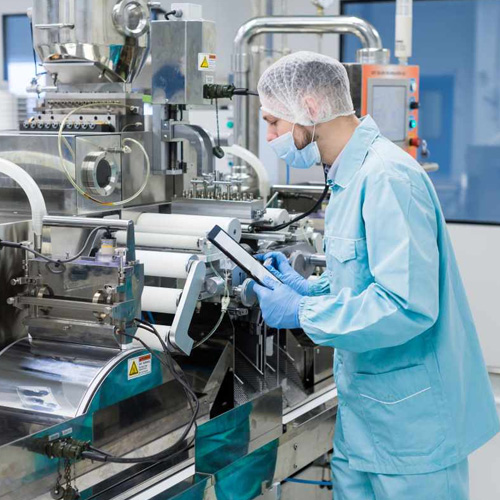

A liquid filling machine is the heart of every pharmaceutical packaging line. It is the equipment that turns a big stainless steel tank of syrup, suspension, oil, eye drop, or sterile injection into thousands of accurately filled, sealed, and labeled bottles or vials — every single day. In 2026, the global market for liquid filling machines is worth over USD 6 billion, and India alone exports more than ₹12,000 crore worth of liquid dosage forms every year. That is why the right filling machine is not a luxury — it is a survival tool for any pharma brand.
This guide explains, in plain English, exactly how a liquid filling machine works, the 6 main types you will see in factories, the working principle of each, the products they handle best, and the most common applications in the pharma industry. We will also cover viscosity, accuracy, speed, and how to pick the right type for your specific product. By the end, you will be able to read any technical brochure and understand every word on it.
Table of Contents
- What Is a Liquid Filling Machine?
- The Working Principle of a Liquid Filling Machine (4 Steps)
- The 6 Main Types of Liquid Filling Machines
- 1. Piston Filling Machine
- 2. Peristaltic Pump Filling Machine
- 3. Gravity Filling Machine
- 4. Vacuum Filling Machine
- 5. Servo-Driven Filling Machine
- 6. Gear Pump Filling Machine
- Comparison Table: Which Type Should You Choose?
- Pharmaceutical Applications by Product
- Key Parts of a Liquid Filling Machine
- Daily Maintenance Checklist
- Frequently Asked Questions
What Is a Liquid Filling Machine?
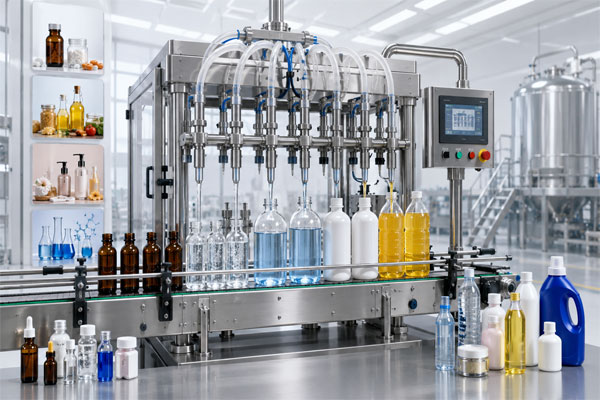
A liquid filling machine is a piece of equipment that measures a precise amount of a liquid product and dispenses it into a container. In the pharmaceutical industry, the term covers everything from a small bench-top unit that fills 10 bottles per minute, to a 20-head rotary line that fills 400 bottles per minute. The goal is always the same: deliver the exact labelled dose, every time, in a clean and validated way.
A modern pharma liquid filler is built to follow current Good Manufacturing Practice (cGMP) rules. That means:
- All product-contact parts are made of SS 316L stainless steel (the same metal used for surgical implants).
- Internal surfaces are mirror-polished to Ra ≤ 0.8 µm so bacteria and product cannot stick.
- Sanitary tri-clamp fittings replace threaded joints, so there are no hidden product traps.
- The machine is designed for Clean-in-Place (CIP) or easy manual cleaning.
- Every critical parameter — speed, volume, temperature — is logged for validation.
The Working Principle of a Liquid Filling Machine (4 Steps)
Every liquid filling machine, no matter how big or small, follows the same 4-step working principle. Once you understand these 4 steps, you can read any machine’s spec sheet and know exactly what is happening inside.
Step 1: Container positioning
The empty bottle, vial, or ampoule is moved into position under the filling nozzle. In a linear machine, this is done by a conveyor with guide rails. In a rotary machine, bottles ride on a rotary table and a star wheel places each one precisely under a nozzle.
Step 2: Volume measurement
The machine measures the exact volume of liquid to dispense. This is done by one of the metering systems we describe below (piston, peristaltic, gear pump, gravity, or vacuum). The measurement is the most important part of the machine — it is what determines the fill accuracy.
Step 3: Dispensing
The nozzle opens and the measured volume of liquid flows into the container. The nozzle design is critical: it must stop drips, prevent foaming, and avoid splashing. Most pharma nozzles are “bottom-up” — they go inside the bottle and fill from the bottom to reduce foam and air bubbles.
Step 4: Container release
The filled container moves to the next station — usually a capper or sealer. The nozzle retracts, the conveyor moves the next empty container into place, and the cycle repeats.
Key Takeaway: The 4 steps are: position, measure, dispense, release. The metering system (Step 2) is what makes one machine different from another. That is why the “type” of a liquid filling machine is named after its metering system.
The 6 Main Types of Liquid Filling Machines
There are 6 common types of liquid filling machines used in pharma factories today. Each one uses a different metering principle, and each is best for a different kind of product.
| Type | Best For | Accuracy | Speed Range |
|---|---|---|---|
| Piston filler | Syrups, suspensions, creams | ±0.5% | 20–200 BPM |
| Peristaltic pump | Eye drops, sterile and shear-sensitive liquids | ±1% | 10–150 BPM |
| Gravity filler | Water, saline and free-flowing thin liquids | ±2–5% | 20–300 BPM |
| Vacuum filler | Bottle filling without dripping | ±1–2% | 20–200 BPM |
| Servo-driven filler | Multi-product lines and fast changeovers | ±0.3–0.5% | 20–400 BPM |
| Gear pump filler | Viscous oils, gels and lotions | ±1% | 20–150 BPM |
Let’s look at each one in detail.
1. Piston Filling Machine
The piston filling machine is the most widely used type in the pharma industry. A piston moves back and forth inside a cylinder. On the back stroke, liquid is sucked into the cylinder. On the forward stroke, the liquid is pushed out through the nozzle into the bottle.
Working principle (piston filler)
- The piston pulls back, creating a vacuum that draws liquid from the bulk tank into the cylinder.
- The piston reaches its set position — this sets the exact volume.
- The piston pushes forward, forcing the liquid through the outlet valve and into the bottle.
- The cycle repeats for the next bottle.
Because the volume is set by the physical stroke length, piston fillers are very accurate (±0.5%). They also handle a wide range of viscosities — from thin oral solutions to thick creams.
Example use case: A syrup manufacturer in Himachal Pradesh uses a 4-head servo piston filler to pack 100 ml, 200 ml, and 500 ml bottles of cough syrup. The machine fills 80 bottles per minute with ±0.4% accuracy. Changeover between sizes takes 12 minutes.
2. Peristaltic Pump Filling Machine
The peristaltic pump filling machine uses a flexible silicone tube that is squeezed by rotating rollers. As the rollers move, they push the liquid forward through the tube. The number of rotations sets the volume.
Why peristaltic is special
The liquid never touches the machine’s metal parts — it only touches the inside of the sterile tube. This is huge for sterile products because:
- You only need to validate and clean the tube, not the whole machine.
- Tube changeover is fast (under 5 minutes).
- There is zero cross-contamination between batches.
- It is ideal for biologics, vaccines, and shear-sensitive molecules.
Limitation: Peristaltic fillers are slower than piston fillers and the tubes wear out every 200 to 500 hours of use. They also struggle with very viscous products.
Best use: For sterile, shear-sensitive, or low-volume sterile products, the peristaltic filler is the gold standard. Just budget for tube replacement and use FDA-grade silicone or EPDM tubes.
3. Gravity Filling Machine
The gravity filling machine is the oldest and simplest type. The bulk tank is placed above the filling nozzles. When the nozzle opens, liquid flows down into the bottle using only gravity. There is no pump or piston.
When to use gravity fillers
- Thin, free-flowing liquids only (water, saline, mouthwash).
- Non-foaming, non-viscous products.
- Low cost is more important than high accuracy.
Warning: Do not use a gravity filler for syrups, suspensions, or any liquid thicker than water. The accuracy drops to ±5% or worse, and you will over-fill and waste expensive product.
4. Vacuum Filling Machine
The vacuum filling machine is a clever design where the bottle itself becomes part of the metering system. A vacuum is applied to the empty bottle, and liquid is sucked in from the bulk tank below until the bottle reaches a set level. No nozzle touches the bottle mouth, so there is no dripping.
Best applications
- Corrosive chemicals (acids, solvents, hydrogen peroxide).
- Foaming liquids (because the vacuum pulls the foam down).
- Glass or fragile containers.
5. Servo-Driven Filling Machine
The servo-driven filling machine is the modern, smart version of the piston filler. Instead of mechanical cams, every motion is controlled by a servo motor and a PLC. This gives three huge advantages:
- Recipe memory: Store 50+ product recipes and recall them at the touch of a button.
- ±0.3% accuracy: Servo control is more precise than mechanical cams.
- Fast changeover: Switch from 50 ml to 500 ml in under 20 minutes with no mechanical adjustments.
If you run a contract manufacturer that switches products every day, a servo-driven filler will save you hours of changeover time every week.
6. Gear Pump Filling Machine
The gear pump filling machine uses two meshing gears to move liquid. As the gears rotate, they trap a fixed amount of liquid between the teeth and push it out through the nozzle.
Best for
- Viscous oils (olive oil, fish oil, cod liver oil).
- Lotions, gels, and thick shampoos.
- Hot-fill products (syrup at 80°C).
Example: A nutraceutical company in Kerala uses a 2-head gear pump filler to pack 500 ml fish oil bottles. The machine handles the viscous oil cleanly, with no dripping and ±0.8% accuracy.
Comparison Table: Which Type Should You Choose?
Here is a quick cheat sheet. Match your product to the right filling type in under 30 seconds.
| Your Product | Viscosity | Best Filling Type |
|---|---|---|
| Water, saline, mouthwash | Thin (1–50 cP) | Gravity or peristaltic |
| Eye drops, sterile injectables | Thin, sterile | Peristaltic |
| Syrup, suspension, tonic | Medium (50–5,000 cP) | Servo piston |
| Honey, oils, shampoo | High (5,000–50,000 cP) | Gear pump or servo piston |
| Cream, ointment, gel | Very high (50,000+ cP) | Servo piston with heated hopper |
| Foaming liquid (soap, hydrogen peroxide) | Thin to medium | Vacuum or peristaltic |
| Corrosive chemical | Thin to medium | Vacuum (no metal contact) |
Pharmaceutical Applications by Product
Here is a list of the most common liquid pharmaceutical products and the type of filling machine used in each case.
| Product | Container | Filling Type | Special Notes |
|---|---|---|---|
| Cough syrup | 100–500 ml glass/PET bottle | Servo piston | Bottom-up fill to reduce foam |
| Oral suspension | 50–200 ml glass bottle | Servo piston with slow agitation | Suspended particles must not settle |
| Eye drops | 5–15 ml plastic dropper bottle | Peristaltic | Sterile tube, ISO 5 environment |
| Injectable vials | 2–100 ml glass vial | Aseptic peristaltic or piston | Inside LAF or isolator, Grade A air |
| Vaccines | Multi-dose vial or prefilled syringe | Aseptic peristaltic | Cold chain, validated VPHP decontamination |
| IV fluids (saline, RL) | 500 ml–1 L soft bag or bottle | Gravity or piston in Grade A | Terminal sterilization after filling |
| Fish oil / cod liver oil | 100–500 ml bottle | Gear pump or piston | Nitrogen blanketing recommended |
| Tonic, health drink | 200 ml–1 L bottle | Servo piston monobloc | Often combined with an ROPP capper |
| Antiseptic solution | 100 ml–5 L can or bottle | Vacuum or piston | Flammable product; use an explosion-proof panel |
| Hand sanitizer | 50–500 ml bottle or pouch | Piston or gravity | High alcohol content; use an explosion-proof motor |
Key Parts of a Liquid Filling Machine
Whether it is a small benchtop unit or a 20-head rotary, every liquid filling machine is made of the same core parts. Knowing the parts helps you talk to suppliers and maintain your machine.
- Hopper / bulk tank: The big SS 316L tank that holds the product. Usually 25 L to 500 L. Some have agitators for suspensions.
- Feed pipe and valve: SS 316L pipe with a tri-clamp sanitary valve that lets product into the metering system.
- Metering system: The piston, pump, or vacuum chamber that measures the volume.
- Filling nozzle: The tip that dispenses the liquid. Pharma nozzles are usually bottom-up, with no-drip shut-off.
- Bottle feeder / star wheel: The mechanical part that places empty bottles under the nozzle. Star wheels are used on rotary machines, conveyors on linear machines.
- Drive system: The motor (servo or AC) and gearbox that powers the machine. Servo is more precise.
- Control panel: The HMI touchscreen (Siemens, Allen-Bradley, Delta) where the operator sets speed, volume, and recipes.
- Conveyor: The SS frame with belt that moves bottles through the line. Pharma conveyors are usually slat chain or roller.
- Clean-in-Place (CIP) ports: Spray balls and piping that let you clean the inside without taking the machine apart.
Daily Maintenance Checklist
- Wipe down the outside of the machine with 70% IPA at the start and end of every shift.
- Check the air pressure gauge (should be 6–7 bar). Low pressure = inconsistent fills.
- Check the hopper level. Never let the machine run dry — it can damage the piston seals.
- Inspect the filling nozzles for drips. Even one drop per cycle wastes product.
- Verify the fill weight on a calibrated balance every hour (sample 5 bottles).
- Listen for unusual sounds. New noises usually mean a loose part or a worn bearing.
- Check all tri-clamp clamps and gaskets. Replace any gasket that is cracked or swollen.
- Clean the conveyor and drip tray at the end of the shift.
- Run a CIP cycle after every product changeover.
- Log all readings in the batch record — regulators will ask.
Frequently Asked Questions
A liquid filling machine is a piece of equipment that measures a precise volume of liquid — syrup, suspension, oil, eye drop, or injectable — and dispenses it into a container such as a bottle, vial, or ampoule. Pharma-grade liquid fillers are made of SS 316L stainless steel, follow cGMP rules, and can be validated for regulated markets.
Most liquid filling machines work in 4 steps: (1) a bottle or vial is positioned under the filling nozzle, (2) the metering system — piston, pump, or gravity — measures the exact volume, (3) the nozzle opens and the liquid is dispensed, (4) the nozzle closes and the filled container moves to the next station (capping, labeling, etc.).
The 6 main types are: (1) Piston filling machine, (2) Peristaltic pump filling machine, (3) Gravity filling machine, (4) Vacuum filling machine, (5) Servo-driven filling machine, and (6) Gear pump filling machine. Each type is best for a different liquid viscosity and accuracy need.
For syrups and oral liquids, a servo-driven piston filling machine is the best choice. It handles medium to high viscosity (up to 50,000 cP), gives ±0.5% accuracy, and can switch between 50 ml and 500 ml bottle sizes in minutes using recipe memory.
For thin, sterile liquids like eye drops and injectables, a peristaltic pump filler is the best choice. The liquid never touches the machine’s metal parts — it only touches the sterile tube. This makes cleaning and validation much easier.
A good pharma liquid filling machine has an accuracy of ±0.5% to ±1%, depending on the technology. Servo piston fillers are the most accurate (±0.3% to ±0.5%). Gravity fillers are the least accurate (±2% to ±5%) and are only used for non-critical products.
In 2026, a small semi-automatic liquid filler in India costs ₹1.5 lakh to ₹5 lakh. A servo-driven automatic piston filler costs ₹5 lakh to ₹25 lakh. A complete monobloc rinser-filler-capper for an oral liquid line costs ₹15 lakh to ₹1.5 crore.
Yes. Modern liquid filling machines use quick-release format parts and recipe memory. You can change from 50 ml bottles to 200 ml bottles in 10 to 20 minutes by swapping nozzles, pistons, and star wheels. Some servo machines even store 50+ recipes.